· 10 min read
Why Budgeting Fails for Most People — And What Actually Works
Budgeting sounds simple.
Write down your income. List your expenses. Save some money. Avoid overspending.
On paper, it looks like basic mathematics. In real life, budgeting is not a maths problem. It is a behaviour problem, a visibility problem, and increasingly, a digital-spending problem.
Most people do not fail at budgeting because they are careless. They fail because traditional budgeting systems were designed for a world where money moved slowly, expenses were fewer, and cash made spending visible.
That world no longer exists.
Today, money leaves our accounts through UPI, cards, subscriptions, EMIs, food apps, grocery apps, auto-debits, wallet payments, online shopping, insurance premiums, investments, and small impulse payments that barely register in the mind.
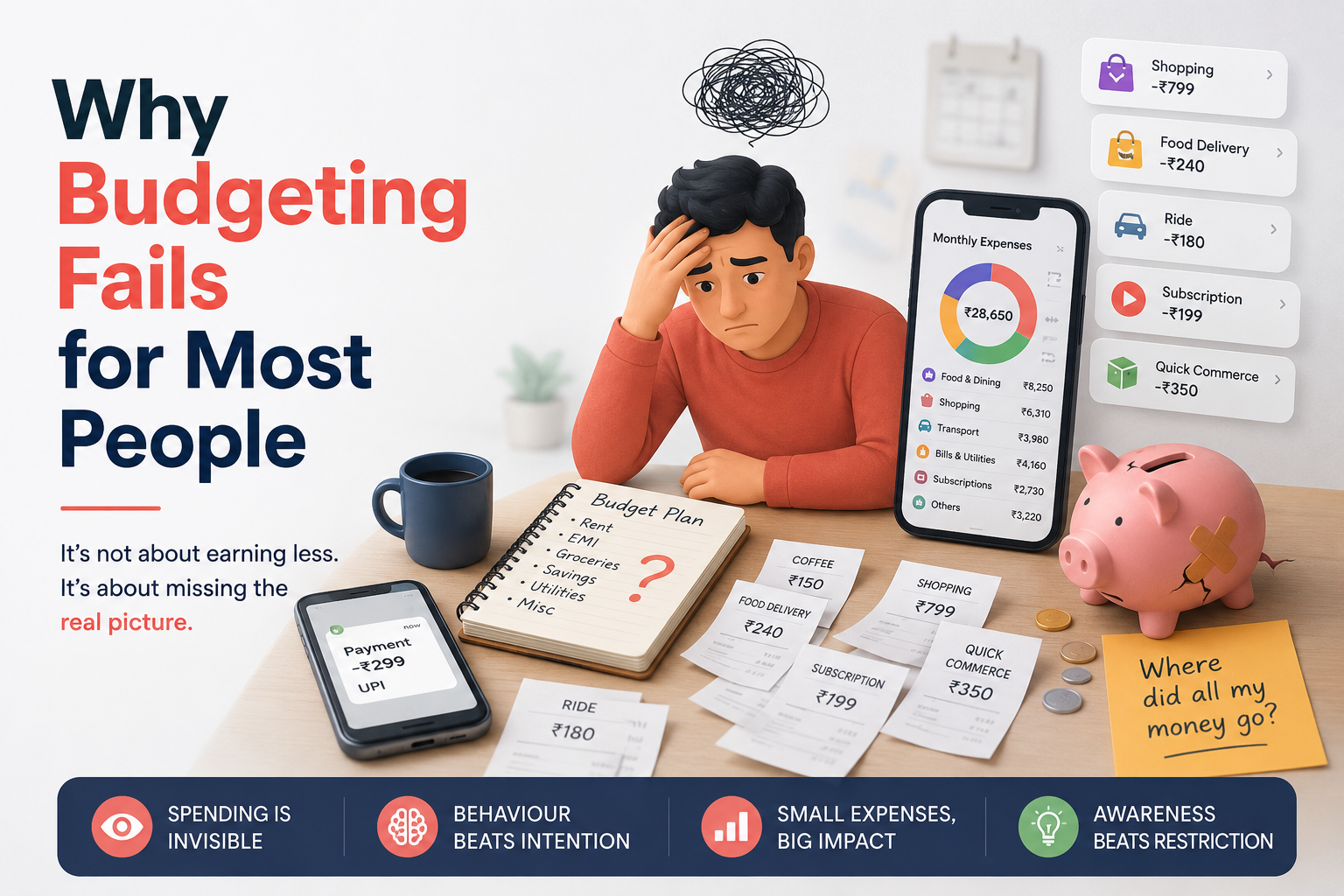
A ₹99 payment here, ₹240 there, ₹799 subscription, ₹1,250 dinner, ₹2,000 fuel, ₹12,000 EMI, ₹4,500 school fee, ₹1,999 shopping order — none of these feels like a financial disaster individually. But together, they quietly decide whether the month ends with savings or stress.
That is why budgeting fails for most people. Not because people do not want control. Because they do not have a clear, real-time view of where their money is actually going.
The Old Budgeting Model Is Broken
The traditional budgeting advice usually sounds like this: follow the 50-30-20 rule, track every expense manually, use a spreadsheet, control unnecessary spending, save before you spend.
These ideas are not wrong. But they assume one thing: that people have the time, patience, discipline, and memory to track their money consistently.
Most people do not. And that is normal.
A person may be disciplined at work, responsible with family, and still fail at budgeting. Because budgeting requires daily attention. It asks people to remember every transaction, categorise expenses, compare against limits, and make better decisions repeatedly.
That is a lot of mental load. The problem is not that people are financially irresponsible. The problem is that the system expects humans to behave like accountants every day.
Spending Has Become Invisible
Earlier, spending had friction. You withdrew cash. You counted notes. You saw your wallet getting lighter. Every payment had a small emotional impact.
Digital payments changed that. UPI and card payments made transactions fast, convenient, and frictionless. That is great for the economy and daily life. But it also makes overspending easier.
India's UPI ecosystem has reached massive scale. In May 2026 alone, UPI processed more than 23 billion transactions worth nearly ₹29.90 lakh crore. That shows how deeply digital payments have entered everyday life.
The issue is not UPI itself. The issue is that digital spending is psychologically different from cash spending. When we pay with cash, we feel the money leaving. When we scan a QR code, tap a card, or approve an auto-debit, the spending feels lighter. The brain does not register the same pain.
Research on UPI users found that around 75% of surveyed participants felt their spending increased after using UPI — because digital payments felt intangible and reduced the guilt usually associated with spending.
That explains why many people look at their bank balance and think: "Where did all my money go?" The answer is usually not one big mistake. It is hundreds of tiny invisible decisions.
Most Budgets Ignore Real Indian Spending Behaviour
A lot of budgeting advice is copied from Western personal finance templates. But Indian households spend differently.
Indian expenses are not always clean, predictable, or individual. A single person may financially support parents, contribute to family functions, pay EMIs, manage rent, send money to relatives, handle medical bills, buy gold, pay insurance premiums, invest in SIPs, and still spend on food delivery, travel, shopping, and entertainment.
Indian financial life is layered. Some expenses are emotional. Some are social. Some are unavoidable. Some are irregular but large. Some are seasonal. Some are family-driven.
A wedding, festival, school admission, hospital visit, vehicle repair, insurance renewal, home repair, or sudden travel plan can destroy a monthly budget instantly.
This is why strict monthly budgeting often fails. It assumes every month is normal. In India, very few months are truly normal.
The Budget Usually Fails After the First Unexpected Expense
Most people create budgets based on ideal months. Salary comes in, rent goes out, EMI is fixed, groceries are estimated, bills are listed, savings target is set. Everything looks sorted.
Then reality happens:
- A medical expense comes up
- A friend's wedding appears
- A family obligation cannot be avoided
- A device breaks
- School fees increase
- Petrol costs more
- A subscription renews
- A festive sale triggers shopping
One unexpected expense creates a budget gap. Then the person feels the budget is already broken. Once that happens, they stop tracking completely.
This is one of the biggest reasons budgeting fails: people treat one mistake as total failure. A good money system should not collapse because one expense was missed. It should adjust.
People Underestimate Small Expenses
Most people remember large payments — rent, EMI, school fees, insurance, SIP, credit card bill. But they underestimate small spending.
Tea, snacks, cab rides, quick commerce, food delivery, mobile recharges, OTT subscriptions, app purchases, pharmacy bills, weekend outings, small UPI transfers, convenience fees, platform charges — these look harmless individually.
But small expenses are dangerous because they do not feel important enough to track.
A ₹150 spend does not feel like a financial decision. But ₹150 spent twice a day becomes ₹9,000 a month. That is the trap. People do not go broke only because of big expenses. Many people lose financial control through repeated low-friction spending.
Budgeting Fails Because It Depends Too Much on Memory
Manual budgeting expects people to remember everything. What did I spend yesterday? Was that ₹650 for groceries or food delivery? Did I pay the electricity bill this month? How much did I spend on Swiggy, Zomato, Blinkit, Amazon, petrol, rent, EMIs, and UPI transfers?
This is not easy. Money data is scattered across SMS, bank apps, card statements, UPI apps, wallets, emails, and payment reminders. Most people do not have one clean view. So they guess. And financial decisions based on guesses are usually wrong.
A person may think they spend ₹5,000 on food delivery when the real number is ₹11,000. They may think subscriptions are small, but ten subscriptions can quietly become a meaningful monthly expense.
Budgeting fails when people do not see the truth.
Present Bias Makes Budgeting Hard
Human beings naturally value today more than tomorrow. This is called present bias — the brain gives more importance to immediate comfort than future benefit. Saving ₹2,000 for the future feels less rewarding than ordering something enjoyable today.
That is why people say: "I will start saving from next month." "I deserve this." "It is just this once." "My salary will come soon." "I will manage later."
These are normal human thoughts. But when repeated often, they damage financial health.
Budgeting fails because it expects people to consistently choose future discipline over present comfort. That is not how most human brains work. A better system should reduce dependence on willpower and increase automatic awareness.
The Problem Is Not Income Alone
Many people believe budgeting will become easy once income increases. That is not always true.
Higher income often leads to higher lifestyle expectations — better restaurants, better gadgets, better travel, better housing, more subscriptions, bigger EMIs, premium services, and larger social spending. This is called lifestyle inflation.
If spending rises at the same speed as income, financial stress continues.
- A person earning ₹40,000 can feel broke
- A person earning ₹1,50,000 can also feel broke
The numbers are different, but the pattern is the same: income comes in, expenses expand, savings become optional, and the month ends with confusion. Budgeting is not only about earning more. It is about understanding the direction of money.
Credit Cards and EMIs Complicate the Picture
Credit cards and EMIs are useful when managed well. But they make budgeting harder because they separate the moment of purchase from the moment of payment. You buy today. You pay later. That delay weakens financial awareness.
A person may feel comfortable spending because the bank balance has not reduced immediately. But the obligation has already been created.
Credit card bills, BNPL payments, personal loans, consumer durable EMIs, app-based loans, and auto-debits create a future spending load. If people do not track that load properly, they overestimate how much money they actually have.
The real question is not: "How much is in my bank account?"
The real question is: "How much is truly available after upcoming EMIs, bills, renewals, and commitments?"
Most budgets fail because they look at current balance, not future obligations.
Financial Shame Makes People Avoid Their Own Data
There is also an emotional side to budgeting. Many people avoid checking their expenses because they already know the answer may hurt.
- They do not want to see how much they spent on food delivery
- They do not want to know how much went into shopping
- They do not want to face the credit card bill
- They do not want to admit savings did not happen again
So they delay. Avoidance gives temporary relief but creates long-term stress.
Budgeting fails when it becomes a guilt exercise. If every review feels like judgement, people stop reviewing. A good money system should not shame the user. It should show reality clearly and help the user improve gradually.
Why Most Budgeting Apps Also Fail
Many budgeting apps fail for the same reason spreadsheets fail: they ask too much from the user. Add every expense manually. Select category. Set budget. Update daily. Review charts. Correct mistakes. Repeat forever.
This works for a very small group of highly disciplined users. But for most people, the habit breaks quickly.
The best personal finance system is not the one with the most features. It is the one that needs the least effort and gives the clearest insight.
People do not need another complicated dashboard. They need answers:
- Where did my money go?
- Which category increased this month?
- Which subscriptions are active?
- What is unusual this month compared to last?
- What can I cut without hurting my lifestyle badly?
- What should I watch before the month ends?
Budgeting Should Start With Awareness, Not Restriction
Most people start budgeting with restriction: stop eating out, stop shopping, cancel everything, spend only on needs. That approach rarely lasts. Restriction creates resistance. The moment people feel deprived, they break the budget.
A better approach is awareness-first budgeting.
Before cutting expenses, understand them. Before judging spending, observe it. Before setting limits, identify patterns.
- You may discover that weekend food delivery is the real leak
- Or that subscriptions are higher than expected
- Or that fuel and commute costs increased
- Or that UPI transfers to family are a major monthly category
- Or that your EMI load is too high
Once you know the pattern, budgeting becomes practical. You stop fighting everything and focus on the few areas that matter.
The Better Way: Budgeting Without Manual Effort
The future of budgeting is not manual entry. It is automatic insight.
A modern money system should read financial signals, organise spending, detect categories, highlight changes, and show users what matters.
Inly helps users understand their spending by turning scattered financial SMS data into clear personal finance insights. Instead of asking users to manually enter every transaction, Inly helps them see patterns across expenses, categories, bills, EMIs, subscriptions, and financial behaviour.
Because the real problem is not that people do not want to budget. The real problem is that they do not have a simple, honest, low-effort way to understand their money.
When users see the truth, better decisions become easier.
Budgeting Does Not Fail Because People Are Bad With Money
Budgeting fails because most systems ignore real human behaviour.
- People forget
- People underestimate small expenses
- People avoid guilt
- People respond to emotions
- People spend differently during festivals, emergencies, weekends, salary days, and stressful periods
- People live in families, not spreadsheets
- People use UPI, cards, wallets, EMIs, loans, and subscriptions — not just cash
So the solution is not to blame people. The solution is to build better financial visibility.
A budget should not be a punishment. It should be a mirror. It should show where money is going, what is changing, and what needs attention.
Once people understand their spending clearly, they do not need extreme discipline every day. They need better awareness, better nudges, and better timing.
That is how budgeting becomes realistic. Not perfect. Realistic. And for most people, that is where financial control truly begins.
Final Thought
Budgeting fails when it depends on memory, guilt, and manual discipline.
Budgeting works when it becomes automatic, visible, and personal.
In today's India, where money moves through UPI, cards, EMIs, subscriptions, and digital apps every day, the old budgeting model is not enough.
People do not need another spreadsheet. They need clarity. They need to know where their money went before the month is over. They need to catch spending patterns early. They need a system that understands real Indian financial life.
That is the future of personal finance.
And that is exactly the problem Inly is built to solve.