· 12 min read
UPI vs Credit Cards: What India's Payment Shift Says About the Economy
India's payment behaviour has changed dramatically over the last decade. Cash once dominated everyday spending. Credit cards were mostly limited to urban, salaried, and premium customers. Digital payments existed, but they were not the default.
Today, UPI has become India's everyday payment language. It is used at tea stalls, kirana stores, restaurants, e-commerce platforms, utility bill counters, petrol pumps, and even between friends and family. At the same time, credit cards continue to grow, but they occupy a very different space. They are no longer the face of digital payments. They are increasingly the face of formal consumer credit.
The real story is not simply "UPI vs credit cards".
UPI shows how India is digitising payments.
Credit cards show how India is financialising consumption.
Together, they reveal how the Indian economy is changing.
UPI: India's Everyday Payment Rail
UPI is arguably one of India's most successful digital public infrastructure stories.
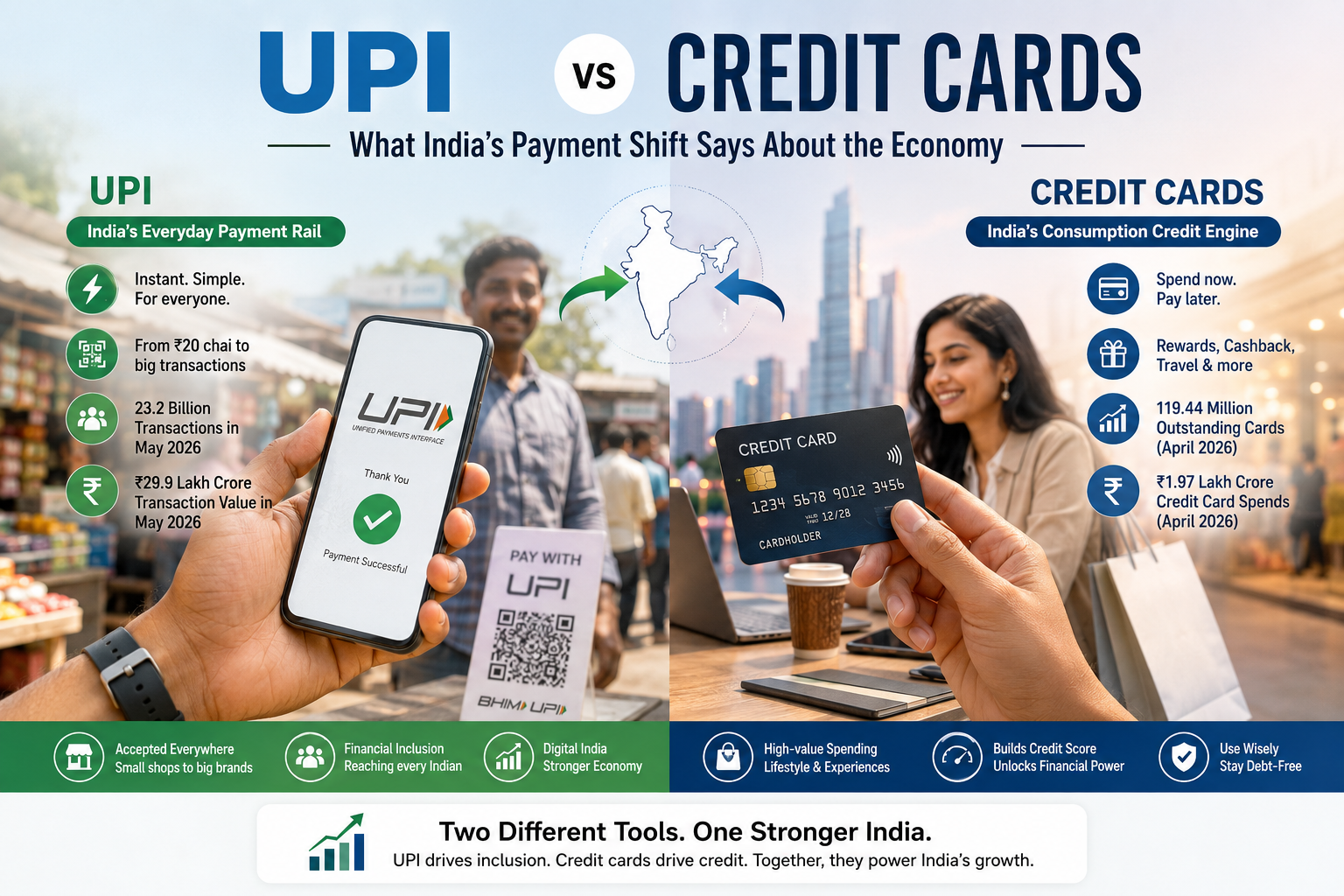
In May 2026, UPI processed more than 23.2 billion transactions worth nearly ₹29.9 lakh crore. These are not just impressive numbers. They show how deeply UPI has entered Indian daily life.
The power of UPI is not only its scale. It is the behaviour it has created.
People use UPI for small payments, large payments, peer-to-peer transfers, rent payments, groceries, food delivery, subscriptions, utility bills, and business collections. It works for a ₹20 chai payment and a ₹20,000 transfer with almost the same ease.
That is why UPI won India.
It did not ask every merchant to install a card machine. It did not require expensive payment infrastructure. It did not depend on customers carrying plastic cards. A simple QR code was enough.
This changed the economics of digital payments. Earlier, accepting digital payments required POS machines, card networks, merchant discount rates, acquiring banks, and settlement systems. UPI simplified this dramatically.
This is why UPI became the payment rail of India's informal-to-formal transition. It made digital payments accessible to the smallest merchant.
Credit Cards: Smaller in Volume, Bigger in Credit Impact
Credit cards are much smaller than UPI in transaction volume, but they remain economically important.
In April 2026, India's credit-card spending was around ₹1.97 lakh crore. This is far below UPI's transaction value and nowhere close to UPI's transaction count. But credit cards play a completely different role.
A credit card is not just a payment tool — it is a credit product. It allows users to spend now and pay later. It gives an interest-free period, reward points, cashback, travel benefits, EMI options, purchase protection, and credit-score building.
For banks, credit cards are attractive because they generate multiple revenue streams — interchange income, annual fees, late fees, interest income, EMI conversion charges, and cross-selling opportunities.
That is why credit cards continue to matter even in a UPI-dominated country.
UPI digitises payments. Credit cards monetise consumption. That distinction is critical.
The Core Difference: UPI Moves Money, Credit Cards Create Credit
The simplest way to understand the difference is this:
UPI usually moves money that already exists in a bank account.
Credit cards create short-term borrowing power.
When someone pays through UPI, money moves instantly from their bank account to another person or merchant. When someone pays through a credit card, they are effectively borrowing from the bank for a short period. If they repay on time, it is a useful financial tool. If they miss payments or revolve the balance, it becomes expensive debt.
- UPI improves payment efficiency — credit cards can increase consumption
- UPI reduces friction — credit cards increase leverage
- UPI improves transparency — credit cards create credit risk if misused
Both are useful. But they solve different problems.
Why UPI Won India's Daily Payments Market
UPI won because it matched Indian behaviour better than cards. India has millions of small merchants. Many operate on thin margins. For them, a simple, low-cost payment method is naturally better than a card machine with hardware cost, settlement dependency, and merchant discount charges.
UPI also fits India's smartphone-first economy. A user does not need to carry a wallet. They do not need to remember card numbers. They do not need to ask whether the merchant accepts cards. They simply scan and pay.
More importantly, UPI created trust. People got instant confirmation. Merchants got instant payment alerts. Customers could see transaction history. SMS notifications and app records reduced hesitation around digital payments.
UPI is not just a payment tool. It is a data layer for the Indian economy. Digital payments create transaction trails. Transaction trails create financial visibility. Financial visibility can support credit assessment, business loans, tax compliance, and better personal money management.
Why Credit Cards Are Still Growing
Despite UPI's dominance, credit cards are not going away. Credit cards are useful when consumers want:
- Rewards, cashback, and travel benefits
- Short-term liquidity for high-ticket purchases
- EMI conversion and purchase protection
- Credit-score building
- Better expense tracking and cash-flow management
For urban salaried Indians, credit cards are often personal finance tools. Used well, they can improve cash-flow management and help users earn rewards. Used badly, they can damage financial health. A disciplined user benefits. An undisciplined user falls into high-interest debt. That is why credit cards are economically powerful but personally risky.
UPI Formalises the Economy. Credit Cards Financialise Consumption.
From an economic point of view, UPI and credit cards are doing two different jobs.
UPI is helping formalise the economy. It brings more transactions into the banking system. It reduces cash dependency. It helps small merchants accept digital payments. It creates transaction records that can support better lending, business profiling, GST compliance, and financial inclusion.
Credit cards are helping financialise consumption. They convert spending behaviour into credit behaviour. They allow banks to understand customers based on income, repayment history, spending categories, and risk profile. They also support discretionary consumption in travel, electronics, dining, fashion, subscriptions, healthcare, and e-commerce.
UPI is the rail. Credit cards are the credit engine. But too much credit without discipline can become dangerous.
The Big Shift: Credit on UPI
The most interesting development is that the boundary between UPI and credit cards is now blurring.
With RuPay credit cards being linked to UPI and banks exploring pre-approved credit lines through UPI, India is moving toward a new model: credit delivered through UPI rails.
This could be massive. A merchant who never accepted credit cards because they did not have a POS machine can now potentially accept credit-card payments through a UPI QR code.
That changes everything:
- For consumers, credit becomes easier to use
- For banks, UPI becomes a new credit distribution channel
- For merchants, ticket sizes may increase
- For fintechs, new monetisation layers open up
- For regulators, a new risk appears: frictionless credit expansion at massive scale
The future may not be UPI versus credit cards. The future may be UPI becoming the front-end for credit.
The Risk: Payment Convenience Can Become Debt Addiction
UPI's biggest strength is simplicity. But when credit becomes deeply embedded into UPI flows, India must be careful.
The risk is not digital payment adoption — that is good. The risk is frictionless borrowing. When borrowing becomes too easy, households may spend beyond income. Credit-card debt is expensive when not repaid on time. Interest charges, late fees, revolving balances, and EMI conversions can quietly damage personal finances.
This is especially important for young earners, first-time salaried employees, gig workers, Tier 2 and Tier 3 consumers, aspirational middle-class households, and people with unstable monthly income.
India's consumer economy is growing, but income growth is uneven. A payment system that improves convenience is healthy. A payment system that encourages impulsive borrowing can become risky.
India needs responsible credit. Not addictive credit.
What This Means for Banks, Fintechs, and Merchants
For banks, credit cards remain profitable but competitive. Banks are no longer chasing only card issuance — they are looking at usage quality, repayment behaviour, customer profitability, and cross-sell potential. UPI-linked credit gives banks a new opportunity to reach customers through existing UPI behaviour. But pushing credit too aggressively through UPI risks rising delinquencies.
For fintechs, UPI is both a blessing and a challenge. It gives massive distribution and behavioural data, but limited direct monetisation. That is why fintech companies are building models around UPI — lending, insurance, merchant services, wealth products, and financial management tools. The future fintech opportunity is not just payments. It is intelligence around payments.
For merchants, UPI was a clear win — it reduced cash handling and made collections easier. Credit-on-UPI could further benefit merchants by increasing purchasing power. But the industry must ensure that credit-on-UPI does not make acceptance confusing again for small merchants who adopted UPI precisely because it was simple.
What This Means for Consumers
For consumers, the rule is simple.
Use UPI for spending control. Use credit cards only with repayment discipline.
UPI is best for everyday payments because it uses money you already have. It gives a real-time sense of spending. It keeps you closer to your actual bank balance.
Credit cards are useful for planned purchases, rewards, credit-score building, and short-term cash-flow management. But they should never be treated as extra income.
A credit limit is not your money. It is the bank's money. That mindset matters.
UPI vs Credit Cards: Which Is Better?
The answer depends on the use case.
- For everyday payments → UPI is better
- For small merchants → UPI is better
- For financial inclusion → UPI is better
- For rewards and cashback → credit cards are better
- For planned high-value purchases → credit cards can be better
- For credit-score building → credit cards can help
- For household financial discipline → UPI is safer
- For banks → credit cards are more profitable
- For the economy → UPI is more inclusive
- For consumption growth → credit cards are more powerful
So the right question is not: which one will win?
The right question is: which one should be used for what?
The Bigger Economic Signal
UPI and credit cards together tell us where India is headed.
India is becoming more digital. More payments are moving from cash to formal rails. More consumers are entering the financial system. More merchants are building transaction records. More banks are using data to underwrite credit. More fintechs are building financial products on top of payment behaviour.
This is a powerful transformation.
But India must not confuse digital adoption with financial health. A person making more digital payments is not automatically financially stronger. A person using more credit is not automatically wealthier.
The real measure of progress is whether households are saving better, borrowing responsibly, spending consciously, and building long-term financial stability.
That is where personal finance awareness becomes critical.
Final View
UPI is India's payment revolution. Credit cards are India's consumption-credit engine.
UPI has democratised digital payments at a scale the world is watching. It has brought small merchants, informal workers, salaried users, families, students, and businesses into one common payment ecosystem.
Credit cards represent a narrower but powerful layer of formal credit. They support aspiration, rewards, convenience, and consumption. But they also carry the risk of overspending and debt stress.
The next phase of India's financial economy will be shaped by how these two systems merge. If India gets it right, UPI-linked credit can expand responsible formal credit to millions. If India gets it wrong, frictionless payments may become frictionless debt.
India does not need to choose between UPI and credit cards.
It needs a system where UPI drives inclusion, credit cards drive disciplined credit, and consumers stay in control of their money.