· 8 min read
UPI Spending Analysis: How India Built the World's Most Successful Digital Payment Revolution
A decade ago, carrying cash was a necessity.
Today, millions of Indians walk into stores, restaurants, vegetable markets, fuel stations, pharmacies, and even roadside tea stalls without carrying a single rupee in cash.
All they need is a smartphone.
This transformation has been powered by one innovation:
UPI (Unified Payments Interface)
What started as a simple payment infrastructure in 2016 has evolved into the backbone of India's digital economy.
Today, UPI is not just changing how India pays — it is changing how India spends, saves, transacts, and participates in the economy.
And perhaps most importantly, it is positioning India as the global leader in digital payments.
The Rise of UPI: A Story of Extraordinary Growth
When UPI was launched in April 2016 by NPCI, few could have predicted the scale it would eventually achieve. In its early days, adoption was modest.
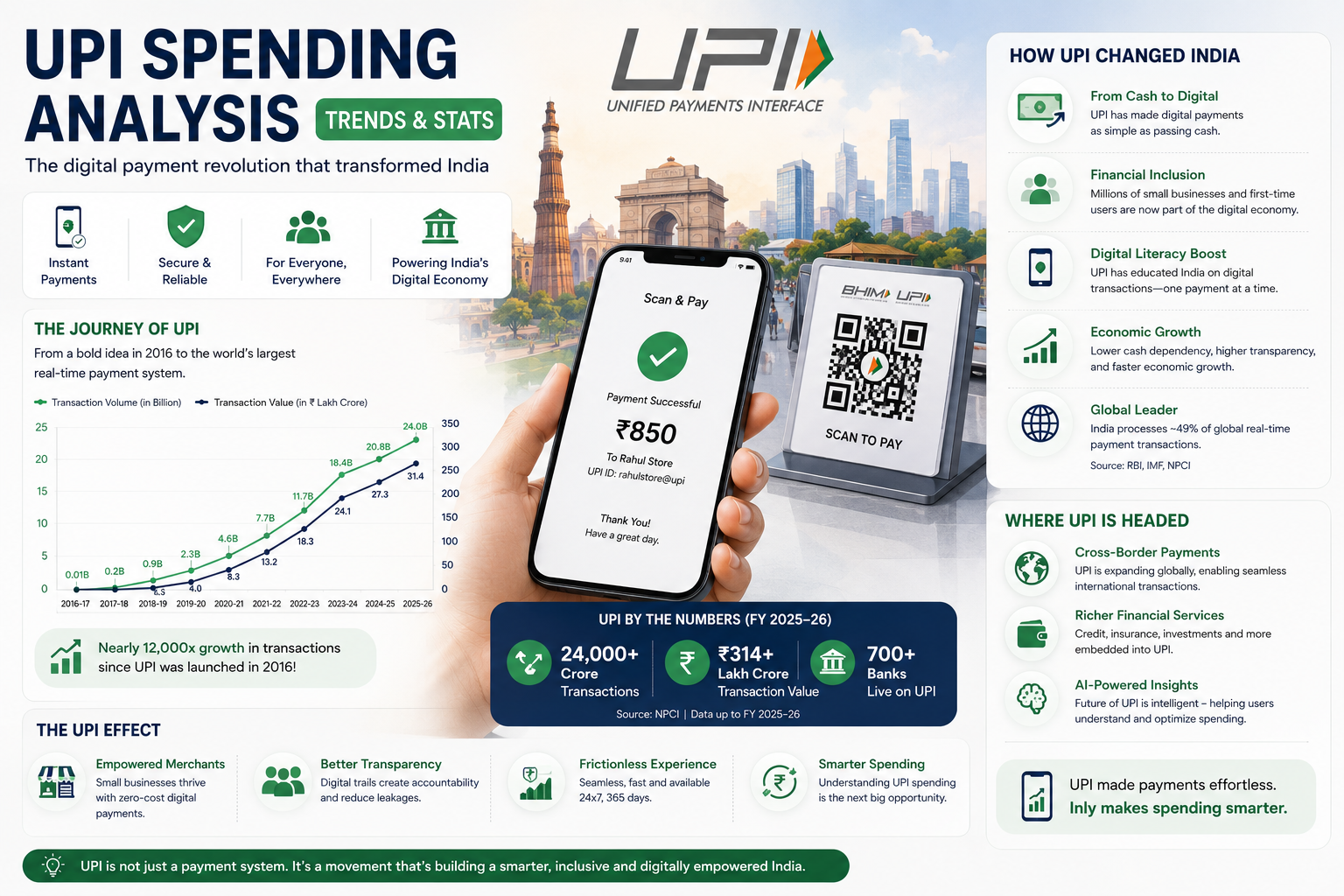
Fast forward to today, and the numbers are staggering. According to NPCI and Government of India data:
- UPI processed more than 24,000 crore transactions during FY 2025-26.
- Transaction value exceeded ₹314 lakh crore in FY 2025-26.
- More than 700 banks are now connected to the UPI network.
- UPI transactions have grown nearly 12,000 times since launch.
In May 2026 alone:
- UPI processed 23.2 billion transactions.
- Transaction value crossed ₹29.9 lakh crore in a single month.
- Monthly transaction volume grew approximately 24% year-over-year.
Very few payment systems anywhere in the world have scaled at this pace.
How UPI Changed Consumer Behavior
Before UPI, digital payments often involved debit cards, credit cards, internet banking, wallets, OTP verification, and multiple payment screens.
UPI simplified everything. A payment that previously required several steps could now be completed through:
- QR codes
- Mobile numbers
- UPI IDs
- Contactless payment flows
The result was a fundamental behavioral shift. Digital payments became faster, easier, more accessible, and available 24x7.
Today, for millions of Indians, paying digitally is often easier than paying with cash.
India's Shift From Cash to QR Codes
For decades, India was largely a cash-driven economy. Small merchants rarely accepted digital payments because hardware was expensive, card fees were high, and infrastructure was limited.
UPI changed that equation completely. Today, QR codes can be found at:
- Street vendors
- Auto-rickshaws
- Kirana stores
- Fruit sellers
- Restaurants
- Shopping malls
The barrier to accepting digital payments effectively disappeared. This democratization of payments has enabled even the smallest businesses to participate in the digital economy.
The Digital Literacy Revolution
One of the most underrated impacts of UPI is how it has improved digital literacy.
Millions of Indians who previously had limited interaction with digital financial services now routinely transfer money digitally, check balances, scan QR codes, review transaction history, and use banking applications.
UPI has effectively become India's largest financial education platform. Without formal training, millions of users have become comfortable with digital identities, banking technology, mobile-first transactions, and financial applications.
This behavioral change is creating long-term economic benefits far beyond payments.
India Is Now a Global Leader in Digital Payments
India's digital payment ecosystem has become a global case study. According to IMF-recognized figures and government data:
- India accounts for nearly 49% of global real-time payment transactions.
- UPI has emerged as the world's largest real-time payment system by transaction volume.
- UPI now represents over 80% of India's retail digital payment transactions.
Countries across Asia, Africa, and other regions are studying India's digital payment model.
What makes UPI unique is not just its scale. It is the combination of open architecture, interoperability, real-time settlement, low transaction costs, and mass adoption — together creating one of the most successful public digital infrastructures in the world.
The Hidden Side Effect: Spending Has Become Easier
While UPI has made payments effortless, it has also created a new challenge.
Spending is now frictionless.
Research has found that many users perceive increased spending after adopting UPI because digital transactions feel less tangible than cash payments.
When money leaves through UPI, cards, auto-debits, and subscriptions, people often lose visibility into where their money is actually going.
This creates a new financial problem:
Convenience without awareness.
People know how much money they have. But many struggle to answer:
- How much did I spend on food?
- How much went to shopping?
- How much was spent through UPI last month?
- Which merchants receive the most money from me?
- Are my monthly expenses increasing?
The Next Evolution: UPI Spending Intelligence
The first phase of India's digital revolution was about enabling payments. The next phase will be about understanding payments.
Consumers increasingly need:
- Spending analytics
- Budget monitoring
- Financial insights
- Category-wise expense tracking
- Personalized financial recommendations
Because making a payment is only one part of financial health. Understanding that payment is equally important.
Where UPI Is Headed Next
Over the next 5-10 years, UPI is likely to evolve beyond simple peer-to-peer payments.
International Expansion
UPI is already expanding into multiple countries and cross-border payment corridors, enabling Indians to transact globally with familiar payment experiences.
Merchant Ecosystem Growth
More businesses will integrate UPI directly into commerce, lending, insurance, and wealth management.
AI-Powered Financial Assistance
The future will combine payments with intelligence. Users won't just make transactions — they'll receive real-time insights about spending patterns, budget adherence, savings opportunities, and financial goals.
How Inly Helps You Understand Your UPI Spending
UPI has made spending easier than ever. But understanding spending remains difficult. That's where Inly comes in.
Inly automatically analyzes transaction activity and transforms it into meaningful financial insights.
With Inly, users can:
- Track UPI expenses automatically
- Understand category-wise spending
- Monitor monthly trends
- Identify recurring payments
- Analyze spending habits
- Build better budgets
Instead of looking at hundreds of individual transactions, users get a clear picture of where their money goes.
Final Thoughts
UPI has transformed India from a cash-first economy into one of the most advanced digital payment ecosystems in the world.
It has improved convenience, expanded financial inclusion, accelerated digital literacy, and established India as a global leader in real-time payments.
But the next challenge is no longer making payments. The next challenge is understanding them.
Because financial awareness starts where transactions end.
India made payments effortless.
Now it's time to make spending understandable.