· 12 min read
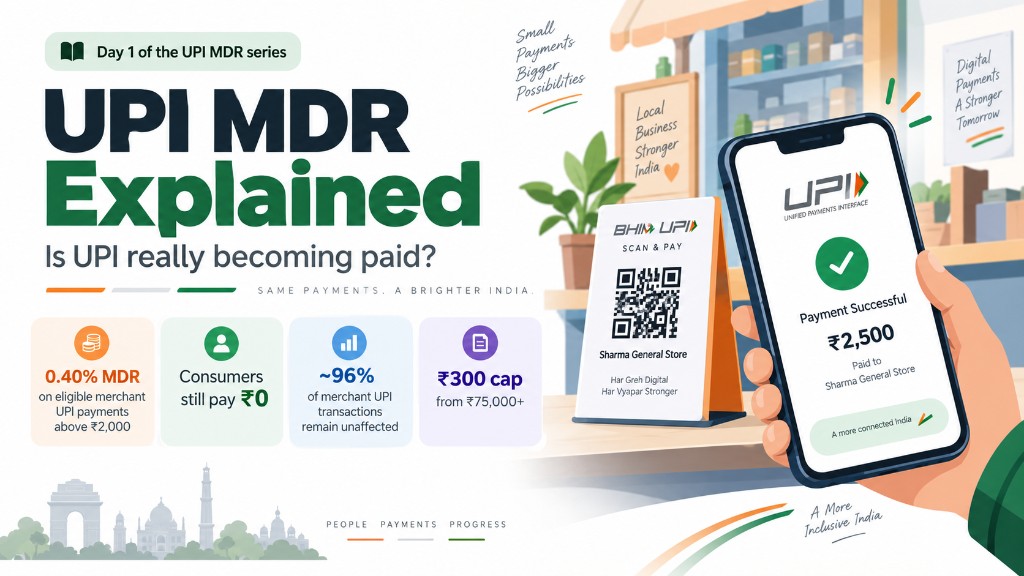
UPI MDR Explained: Is UPI Really Becoming Paid?
For years, UPI has been synonymous with one thing: free digital payments.
That is why the recent announcement around UPI Merchant Discount Rate, or MDR, has created so much confusion.
The simplest interpretation floating around is:
“UPI payments above ₹2,000 will now be charged.”
That is not accurate.
From 15 October 2026, a new MDR framework will apply to a limited category of bank-account-funded merchant UPI transactions above ₹2,000.
But consumers will still not pay any fee. Person-to-person transfers will remain free. Most small-ticket merchant payments will remain free. And many small merchants will continue to be exempt even when individual transactions cross ₹2,000.
So the real change is not that “UPI is becoming paid.” The real change is this:
India is introducing selective merchant-side monetisation for higher-value UPI transactions.
That distinction matters. This is Day 1 of Inly’s UPI MDR series — a clear explanation of what is changing, who pays, and what stays free.
What Exactly Is Changing?
For ordinary Person-to-Merchant, or P2M, UPI transactions, the new framework works like this:
- Transaction value: Up to ₹2,000 — No MDR
- Transaction value: Above ₹2,000, below ₹75,000 — Merchant-side MDR
- Transaction value: ₹75,000 and above — Maximum cap
The MDR is charged to the merchant ecosystem. It is not a consumer fee.
- MDR: ₹1,500 — Below the threshold
- MDR: ₹3,000 — 0.40% of full value
- MDR: ₹10,000 — 0.40% of full value
- MDR: ₹50,000 — 0.40% of full value
- MDR: ₹1,00,000 — Capped, not ₹400
The 0.4% Applies to the Full Transaction Value
One important point is often missed: the 0.4% applies to the full transaction value. It does not apply only to the amount above ₹2,000.
₹3,000 × 0.4% = ₹12 — not ₹4
Consumers Still Pay Zero
This is the most important clarification.
The new framework does not introduce a direct fee for consumers using normal UPI. You are not supposed to see “UPI usage fee: 0.4%” added to your payment.
Person-to-person transfers also continue to remain free. And UPI apps are not permitted under the announced framework to simply start charging consumers a platform fee for regular UPI usage.
- Send ₹20,000 to a friend: P2P remains free
- Pay ₹800 at a restaurant: Below ₹2,000 — no standard MDR
- Pay ₹1,500 for groceries: Everyday merchant tickets stay free
- Eligible high-value merchant payment: MDR sits on the merchant side
The economic impact begins mainly when a merchant receives an eligible higher-value transaction.
Most UPI Merchant Transactions Will Still Be Unaffected
This is where the scale of the change becomes clearer.
More than 95% of UPI merchant transactions by volume are ₹2,000 or below. Government communication puts the unaffected share at roughly 96% of merchant transactions once small-merchant protections are considered.
That means the new MDR does not touch the overwhelming majority of everyday UPI transactions.
- Merchant transactions: Unaffected share — Including small-merchant protections
- Typical ticket: Tea / snacks — Well below ₹2,000
- Typical ticket: Cab / auto — Still free of standard MDR
- Typical ticket: Restaurant bill — Still below the threshold
The policy is primarily aimed at a relatively smaller set of higher-value merchant payments.
Small Merchants Are Also Protected
Another misconception is that any merchant receiving more than ₹2,000 in a single transaction must pay MDR.
That is not necessarily true.
Merchants classified under P2PM can continue to receive UPI payments at zero MDR if their inward UPI receipts remain within the prescribed small-merchant limit of ₹1 lakh per month.
That means even a single payment above ₹2,000 can remain free for an eligible small merchant.
- A small vendor receives ₹3,500 — Above ₹2,000 — but that alone is not enough
- Merchant is validly P2PM — Classification matters as much as ticket size
- Monthly inward UPI stays within ₹1 lakh — Prescribed small-merchant threshold
- Transaction stays at zero MDR — No automatic 0.4% just because the amount crossed ₹2,000
Some Sectors Get Special Concessions
The standard 0.4% rate also does not apply uniformly to every category. Several sectors receive concessional treatment.
- Railways, telecom, insurance, fuel, electricity, municipal water, piped gas: Utilities & essentials — For qualifying transactions above ₹2,000
- Certain mutual fund / securities-related payments: Capital markets — Capped at ₹300
- Concessional treatment: Education — No single universal public rate for every education transaction
So the headline “0.4% above ₹2,000” is useful — but incomplete.
Why the ₹300 Cap Matters
Without a cap, 0.4% could become expensive on high-value payments. For example, 0.4% of ₹1 lakh = ₹400.
But under the new framework, standard eligible transactions of ₹75,000 and above are capped at ₹300.
That means the effective MDR percentage actually falls as transaction size increases beyond ₹75,000.
- Effective MDR: ₹1 lakh — ₹300 / ₹1,00,000
- Effective MDR: ₹2 lakh — ₹300 / ₹2,00,000
- On ₹1 lakh: Without cap — 0.4% with no ceiling
- From ₹75,000+: With cap — Standard framework maximum
This cap significantly changes the economics for high-ticket payments.
Can Merchants Simply Add 0.4% to Your Bill?
Under the announced framework, they should not.
An explicit line item such as “UPI MDR charge: 0.4%” would amount to directly passing the merchant MDR to the customer. That is not permitted under the announced rules.
However, merchants can still react economically in other ways. They may choose to absorb the cost, reduce discounts, renegotiate suppliers, optimise another operating expense, or revise overall pricing.
So consumers may still experience some indirect impact over time. But that is very different from consumers directly paying 0.4% every time they use UPI.
The Biggest Myths — Quickly Cleared Up
- Myth: Every UPI payment above ₹2,000 now costs 0.4% — Reality: False — only eligible merchant transactions, not all UPI
- Myth: The customer pays the MDR — Reality: False — MDR is merchant-side
- Myth: Only the amount above ₹2,000 is charged — Reality: False — the rate applies to the entire eligible transaction
- Myth: Every small merchant receiving ₹3,000 must pay — Reality: False — P2PM merchants within the monthly threshold can remain exempt
- Myth: A ₹1 lakh transaction attracts ₹400 MDR — Reality: False — standard MDR is capped at ₹300 from ₹75,000 upward
- Myth: Fuel, insurance and utility payments all attract 0.4% — Reality: False — several designated categories receive concessional treatment
- Myth: PhonePe or Google Pay can now start charging consumers — Reality: Not under this framework — consumer UPI usage remains protected
So Is UPI Still Free?
For consumers, largely yes. For P2P transfers, yes. For the vast majority of small-value merchant transactions, yes. For qualifying small merchants, yes.
What has changed is that higher-value commercial UPI transactions are beginning to contribute towards the economics of running the payment infrastructure.
That is a major policy shift. But it is not the same thing as ending free UPI.
The better way to describe it is:
India is moving from universal zero-MDR towards selective merchant-funded UPI.
That is the real story.
And once we look beyond the headline, the next question becomes much more interesting: why did India decide to introduce MDR now, after years of zero-MDR UPI?
That is where the economics of UPI becomes much bigger than the 0.4% headline — and it is what Day 2 of this series will unpack.
Sources and framing reflect the announced UPI MDR framework effective 15 October 2026 for eligible bank-account-funded merchant transactions. Rates, caps, sector concessions and P2PM thresholds are as publicly described; category eligibility can depend on merchant classification and transaction type. Examples are illustrative and do not constitute legal, tax or payment-acceptance advice.