· 15 min read
UPI Credit Lines Explained
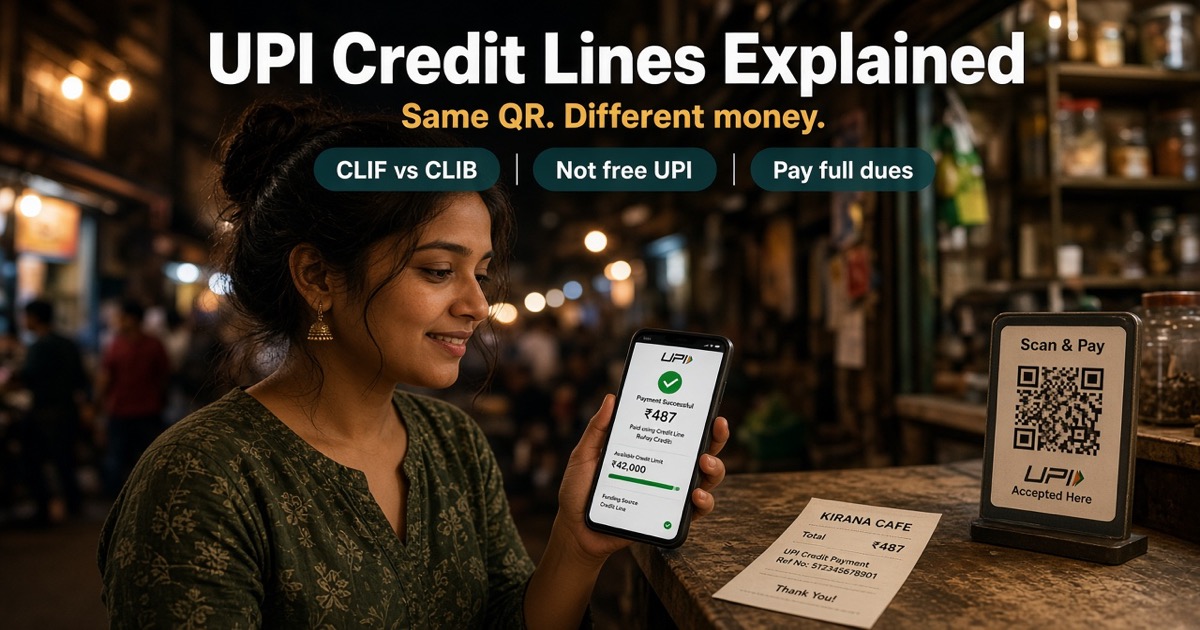
You scan a kirana QR. The green tick appears in a second. It feels exactly like paying from your savings account.
It might not be.
India has quietly bolted credit onto the country’s most frictionless payment rail. Link a RuPay credit card to UPI, or tap a pre-sanctioned bank credit line as a UPI funding source, and the same interface that emptied your salary can now draw on borrowed money — often without the plastic card ever leaving your wallet.
UPI credit does not change the QR. It changes whose balance falls — and whether interest has already started.
Two Products People Mix Up
“Credit on UPI” is not one product. Households usually meet two related ideas:
- Card linked to UPI: RuPay Credit on UPI — Spends post to your RuPay credit card statement
- Bank credit as UPI source: Pre-sanctioned credit line — CLIF (interest-free window) or CLIB (interest from day one)
RBI’s September 2023 circular enabled payments through a pre-sanctioned credit line issued by a scheduled commercial bank to an individual, with the customer’s prior consent, on the UPI system. Banks set limit, credit period and interest under board-approved policy. In February 2025 the facility’s scope was extended to Small Finance Banks. Payment banks and regional rural banks remain outside the original SCB framing.
Later clarifications (including June 2026 amendments for commercial banks and SFBs) stress a simple idea: the prudential treatment follows the underlying credit facility — UPI is the delivery channel, not a free pass around credit rules.
Why This Matters in a UPI Country
UPI is no longer a side rail. RBI’s Annual Report shows UPI handled about 24,16,169 lakh transactions worth ₹314.2 lakh crore in FY 2025–26 — roughly +30% volume and +20.6% value year-on-year — and about 86% of retail payment transactions by volume.
Credit cards remain smaller but meaningful: about 60,238 lakh credit-card payment transactions worth ₹23.6 lakh crore in FY26. Credit-on-UPI is the bridge that lets card-like credit show up where Indians already pay — the QR.
- Transaction value: UPI FY26 — +20.6% YoY
- Of retail volume: UPI share — FY 2025–26
- Card payments: CC value — FY26 PoS/online
- Txns (Apr–Oct FY25): RuPay-UPI — ₹63,826 cr value
- RuPay-UPI pace: Vs FY24 — 36.3 cr txns full year
Finance Ministry / NPCI-linked reporting cited in the business press put RuPay credit-on-UPI at over 750 million transactions and about ₹63,826 crore from April–October FY25 — versus about 363 million transactions and ₹33,439 crore in the whole of FY24. NPCI leadership has also said RuPay accounts for roughly 16% of credit-card spends, with about half of that RuPay spend happening on UPI.
Industry estimates (for example Bernstein, as reported by Mint) suggest RuPay-on-UPI can be a large share of credit-card transaction counts while a much smaller share of spend value — high-frequency, smaller-ticket credit behaviour riding the QR habit.
- ₹33,439 cr: FY24 full
- ₹63,826 cr: FY25 Apr–Oct
CLIF vs CLIB: The Interest Distinction That Saves You Money
NPCI’s UPI framework (including the September 2026 consolidated circular coverage in the press) distinguishes interest-free and interest-bearing credit lines:
- Window product: CLIF — Pay full dues by due date — or interest arrives
- Interest-bearing: CLIB — Clock starts with the transaction
- Card rules apply: RuPay CC — Interest-free period if you clear total due
- Looks harmless: Min due only — Revolving cost can rival card APRs
If the UPI screen just says “Credit,” open the Key Fact Statement / product terms. CLIF behaves closer to a disciplined card cycle. CLIB can price like a mini personal loan from the first chai you put on the line.
Where Credit on UPI Works — and Where It Doesn’t
Feature access depends on product type and issuer rules. A practical map drawn from NPCI’s consolidated UPI circular (as summarised in September 2026 reporting):
- Yes: Merchant payments (P2M) — RuPay CC / CLIF / CLIB*
- Yes: UPI AutoPay & Reserve Pay
- Yes: EMI conversion (where offered)
- Limited: P2P transfers — CLIB only (end-use rules)
- No: P2P — RuPay CC / CLIF
- No: UPI Lite / UPI Circle
*CLIB merchant use can be limited to permitted end-uses. RuPay credit on UPI typically allows UPI International where enabled; CLIF/CLIB generally do not. Always confirm in your bank/app — NPCI sets rails, issuers set who gets credit and on what terms.
Members and UPI apps were given a mid-December 2026 implementation window in that circular cycle to standardise account subtypes and references so the funding source is clearer at checkout.
How a Household Should Think About It
Credit on UPI wins on convenience. It loses when the brain still labels the spend as “UPI money I already had.”
- Identify the source — Savings · RuPay card · CLIF · CLIB — say the name out loud.
- Read the cost clock — Interest-free until due date, or interest from transaction day?
- Cap everyday use — Groceries and chai on credit train utilisation without feeling like borrowing.
- Pay total due — Minimum due is how revolving debt hides inside a QR habit.
- Separate Autopay risk — Subscriptions on credit-UPI can stack silently until the statement shocks you.
- Behaviour: Frictionless credit spends more than plastic — No card wallet moment → weaker mental accounting.
- Cash flow: Pay-day and due-date must both fit — A 45-day interest-free window still needs cleared dues.
- Bureau: It is still credit reporting territory — Missed dues can show up like any other revolving facility.
- Merchant: QR acceptance ≠ rewards paradise — Small-ticket MDR rules and MCC quirks affect cashback — read the fine print.
Worked Money Examples (Educational)
- Debit UPI: From savings — Balance falls today · no due date stress
- Pay full due: CLIF / RuPay CC — *If cleared inside interest-free rules
- Revolve habit: CLIB / min due — Interest + possible late fees compound fast
True monthly credit-UPI cost ≈ Interest + late fees + foregone rewards exclusions − cashback actually credited
Myths That Turn Green Ticks into Red Statements
- Myth: Myth: If it is on UPI, it is free like bank-transfer UPI — Reality: Reality: Funding source can be a credit line or card — cost rules apply
- Myth: Myth: Pre-approved limit means I should use it daily — Reality: Reality: Limit is the bank’s risk appetite, not your surplus
- Myth: Myth: EMI on UPI spend is always cheaper — Reality: Reality: Conversion interest and fees can erase the “no-cost” illusion
- Reasonable — Short float you will clear in full; rewards you actually redeem; tight tracking
- Caution — Autopay for OTTs/utilities on credit while salary timing is tight
- Risky — Everyday spends on CLIB; stacking mini EMIs; paying only minimum due
- Avoid — Using credit-UPI as a lifestyle income top-up with no repayment plan
A Practical Setup Checklist
- Keep savings UPI as default — Make credit a deliberate switch, not the home screen default
- Name the product in the app — RuPay card vs CLIF vs CLIB — no anonymous “Credit” habit
- Calendar the due date — Same seriousness as a credit-card bill
- Cap utilisation — High usage on small tickets still looks like stress to underwriters
- Review statement weekly at first — Until the mental model matches the product
Inly Perspective: See Which Balance Actually Moved
The hard part of credit-on-UPI is invisibility. The QR feels identical; the liability is not.
Inly helps you reconnect payment SMS and spending patterns so you can answer:
- Which UPI spends hit savings versus a credit product this week?
- Are Autopay mandates stacking on top of EMI and card dues?
- Is “small” QR credit quietly filling the statement before payday?
- What must be paid in full this cycle so interest never starts?
Convenience is a feature. Clarity is the safeguard.
Bharat’s Money Lens. Understand Before You Spend.
Frequently Asked Questions
Is a UPI credit line the same as a personal loan?
Not exactly. A personal loan usually disburses a lump sum to your account with a fixed EMI schedule. A UPI credit line is a pre-sanctioned facility you draw through payments (and sometimes related features). Pricing, tenure and reporting still follow the underlying credit product your bank sanctioned.
Can I send money to friends on a credit line?
RuPay credit on UPI and CLIF generally do not allow P2P. CLIB may allow P2P subject to permitted end-use and issuer rules. Do not assume every credit source can pay anyone.
Does using credit on UPI hurt my credit score?
Responsible use with full repayment can be neutral-to-constructive over time. Missing dues, revolving heavy balances or stacking facilities can pressure your bureau file like other unsecured credit.
Should I put every QR payment on credit for rewards?
Only if you clear total dues every cycle and the rewards after exclusions still beat the behavioural risk of spending more. Many households are better off keeping daily UPI on savings.
Final Takeaway
UPI credit lines explained in one line: the QR stayed simple; the funding source got complicated.
• RuPay credit-on-UPI and pre-sanctioned lines (CLIF/CLIB) are related but not identical • RBI enabled bank credit lines on UPI (SCBs; later SFBs) with customer consent and board-set terms • RuPay-UPI volumes have scaled fast (75 cr+ txns / ~₹64k cr in Apr–Oct FY25 alone per reported MoF figures) • CLIF can be interest-free if you pay in full; CLIB may charge from day one • Pay total due, keep savings as default, and treat Autopay-on-credit as real debt
Same green tick. Ask which balance just moved.
Understand your money before you spend it.
Download Inly and see how UPI, EMIs and subscriptions actually hit your month — before credit-on-UPI turns convenience into a revolving surprise.
Inly — Bharat’s Money Lens. Understand Before You Spend.
Sources: Reserve Bank of India circular CO.DPSS.POLC.No.S-567/02-23-001/2023-24 (4 Sep 2023, updated 12 Feb 2025) on operation of pre-sanctioned credit lines through UPI; RBI press release extending scope to Small Finance Banks (12 Feb 2025); RBI Annual Report payment-system tables (UPI and credit-card turnover FY 2025–26); RBI commercial bank / SFB credit-facility amendment directions (Jun 2026) clarifying prudential treatment of payment-linked credit; Ministry of Finance / NPCI-linked figures on RuPay credit-on-UPI volumes and value (FY24 vs Apr–Oct FY25) as reported in Business Standard and Mint; NPCI leadership comments on RuPay share of card spends; NPCI UPI Consolidated Circular feature matrix for RuPay CC / CLIF / CLIB as summarised in September 2026 press coverage (implementation standardisation timeline). Product terms vary by issuer. This is educational content, not personalised lending or investment advice.