· 14 min read
The True Cost of Impulse Purchases: What They Do to Indian Households
A ₹299 late-night food order. A ₹799 sale purchase. An unnecessary quick-commerce add-on. A subscription you forget to cancel. A gadget bought on EMI because the monthly instalment “looks manageable.”
Individually, these purchases rarely feel dangerous. But their true cost is almost never the number on the checkout screen.
Repeated impulse spending quietly eats into savings, delays investments, creates avoidable EMIs and leaves households less prepared for genuine emergencies. In India’s increasingly frictionless digital economy — where UPI, one-click checkout, quick commerce and consumer credit are everywhere — this is becoming a serious personal-finance issue.
The problem is not that Indians are spending more. The problem is spending without awareness, without a plan and, increasingly, without paying for it immediately.
What Is an Impulse Purchase?
An impulse purchase is not simply an unnecessary purchase. It is a purchase made without properly considering:
- Is it genuinely needed?
- Was it budgeted for?
- Is a cheaper or better alternative available?
- Can the household comfortably afford it?
- What important financial goal will it displace?
- Would I still buy it without the discount, urgency message, EMI or social pressure?
A planned family dinner, a festive gift, a phone replacement or a hobby expense can be completely sensible. The issue begins when a temporary desire is repeatedly mistaken for a financial priority.
Why This Matters in India
India is a consumption-led economy. Private final consumption expenditure was estimated at 61.5% of GDP in FY26, which means household spending is one of the country’s biggest growth engines.
But not all consumption creates the same value. Spending on food, healthcare, education, insurance, transport, skill-building and essential durable goods can improve a household’s quality of life and productivity. Unplanned spending on convenience, upgrades, subscriptions, delivery charges, fashion, gadgets and lifestyle purchases may bring quick satisfaction — but can weaken the household’s financial position.
- PFCE as % of GDP: Consumption share — FY26 estimate
- Monthly per capita: Rural spending — 2023–24 average
- Monthly per capita: Urban spending — 2023–24 average
- Rural / urban: Non-food share — Where unplanned spending hides
For a four-member household, those averages work out to roughly ₹16,500 a month in rural India and ₹28,000 in urban India.
Non-food expenses now account for 53% of rural consumption and 60% of urban consumption. That is precisely where unplanned spending tends to hide.
The ₹500 Illusion
The most damaging impulse purchases are often not expensive. They are simply frequent.
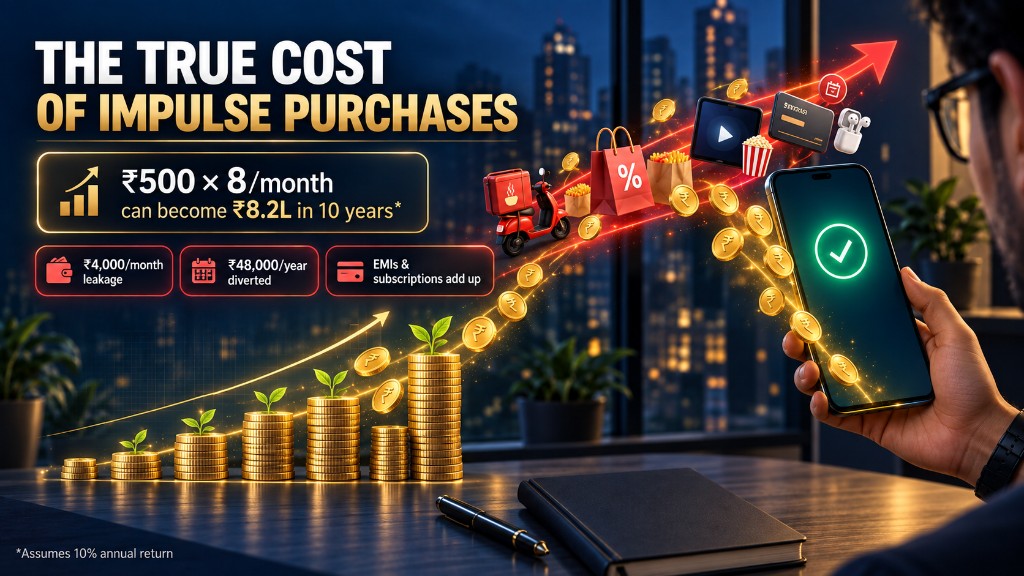
A ₹500 expense may feel too small to matter. But if you have ₹10,000 available each month for investing, that ₹500 is 5% of your potential monthly wealth creation.
Now imagine eight such purchases every month.
- 8 × ₹500: Monthly leakage — Feels invisible in the moment
- Per year: Annual leakage — Roughly a month’s income for many households
- Over 10 years: Direct outflow — Money simply spent
- At 10% annually: If invested instead — The real cost of the habit
The point is not to eliminate every small pleasure. The point is to recognise that financial damage usually comes from frequency, not ticket size.
The Price Tag Is Only One Part of the Cost
Every impulse purchase carries more than one cost.
- Purchase cost: Money leaves the account immediately
- Budget displacement: Less remains for SIPs, insurance, debt repayment or emergencies
- Opportunity cost: Money loses years of potential compounding
- Financing cost: Card interest, late charges and BNPL instalments raise the real price
- Subscription drag: A small monthly payment becomes a large annual expense
- Waste cost: The item may be duplicated, barely used or forgotten
- Behavioural cost: Spending becomes an automatic response to stress, boredom or discounts
This is why the price shown on the app is often the least important part of the decision.
Digital Payments Made Spending Easier — and Less Visible
UPI is one of India’s greatest financial innovations. It has made payments fast, accessible and convenient.
But convenience has a side effect: it reduces friction.
Cash creates a natural pause. You see the notes leave your hand and your wallet become lighter. A saved card, UPI payment or one-click checkout takes seconds. The decision to spend is separated from the emotional moment of paying.
- The trigger arrives — A deal, a social-media recommendation or a notification
- Urgency is manufactured — “Limited stock”, “offer ends in 10 minutes”, “add ₹150 for free delivery”
- Payment takes seconds — Saved card, UPI or one-click checkout — no pause to reconsider
- The debit disappears — It becomes one line in a long list of small transactions
- Month-end confusion — Money feels short, but no single large mistake is visible
That is why tracking categories alone is not enough. A household should also understand its spending triggers: convenience, stress, boredom, sale pressure, celebration or genuine need.
Quick Commerce Is Changing the Meaning of “Urgent”
Quick commerce is genuinely useful for medicines, forgotten groceries, baby products and real household needs.
But it can also create a new habit: every small desire can be fulfilled in minutes.
India’s quick-commerce market is estimated at $10–11 billion in gross merchandise value and is projected to reach $65–70 billion by 2030. Essentials still account for most spending, but platforms are expanding rapidly into beauty, snacks, electronics, gifting, pet products and lifestyle categories — areas where impulse buying is common.
- Today: Market size — Gross merchandise value
- By 2030: Market size — Projected growth
- Today: Category mix — Groceries and daily needs still dominate
- Expanding into: Category mix — Beauty, snacks, electronics, gifting, pet products
The risk is not using 10-minute delivery. The risk is treating speed as a reason to buy.
A Discount Is Not Always a Saving
Indian consumers are surrounded by offers: Republic Day sales, Prime Day, Big Billion Days, festival sales, app-only offers and “exclusive” bank discounts.
A discount saves money only when all three conditions are true:
- You had already planned to buy the item.
- You genuinely need it.
- The final price is actually better than available alternatives.
If you spend ₹1,500 on something you would otherwise never have bought, a 50% discount has not saved ₹1,500. It has spent ₹1,500.
E-commerce is not the enemy. It gives consumers choice and price transparency. But households must learn to distinguish between price discovery and desire creation.
Credit Turns an Impulse Into a Future Obligation
Impulse spending gets more dangerous when it is financed.
India’s household debt reached 45.5% of GDP by September 2025, while non-housing retail loans accounted for 58.4% of household borrowings by March 2026.
Not all debt is bad. A home loan, education loan, productive business loan or carefully planned vehicle loan can have genuine long-term value. But debt used for consumption, upgrades and convenience is much harder to justify.
- Of GDP: Household debt — As at September 2025
- Of household borrowings: Non-housing retail — As at March 2026
- Home, education, business: Productive debt — Builds an asset or capability
- Upgrades, convenience: Consumption debt — Spends future income early
A credit card is useful when it is a payment instrument. It becomes dangerous when it becomes an income substitute.
Credit-card minimum due is especially misleading. It prevents immediate default, but it does not solve the debt. The RBI itself requires issuers to make clear that paying only the minimum amount due does not avoid interest on the unpaid balance.
The EMI Trap: Affordability Is Not the Instalment
A ₹36,000 purchase can feel expensive. The same purchase at ₹3,000 per month can feel harmless.
That is the EMI trap. Before taking an EMI or BNPL offer, ask:
- Would I buy this if I had to pay the full amount today?
- Is it replacing something genuinely needed — or merely upgrading it?
- Are there processing charges, GST, insurance or compulsory add-ons?
- How many EMIs already exist in the household?
- Will this payment still feel comfortable if income drops for three months?
One EMI may be manageable. Five “small” EMIs can quietly crush free cash flow.
What Impulse Spending Really Displaces
The biggest loss is usually not visible in the purchase itself. It is visible in what never gets funded. Repeated unplanned spending can delay:
- A six-month emergency fund
- Health and term-insurance premiums
- Higher-interest loan prepayment
- Retirement investments
- A child’s education corpus
- A home down payment
- Medical contingencies
- A career transition or business opportunity
For most middle-class families, the difference between financial stress and financial resilience is not income alone. It is the ability to consistently convert income into assets.
Festival Spending: Meaningful, but Worth Planning
Indian festivals are about family, faith, travel, gifting and celebration. The answer is not to stop spending.
But festivals are also when discounts, social expectations and credit offers arrive together.
The smarter approach is to create a festival fund before the festival season begins. Saving ₹2,000 a month for six months gives you ₹12,000 to spend without card interest, post-festival regret or a dent in your emergency savings.
Spend joyfully — but spend from a plan.
A Practical Anti-Impulse System
The answer is not extreme restriction. A budget with no room for joy will not last. The better approach is controlled freedom.
- Set an impulse-spending allowance — Fix a monthly amount for non-essential spending; once used, purchases wait
- Follow a waiting rule — Put a deliberate delay between wanting something and buying it
- Invest before you spend — Automate savings, SIPs, insurance and debt prepayment on salary day
- Audit subscriptions every quarter — Review OTT, cloud, apps, memberships, fitness and auto-renewing tools
- Track the reason behind the purchase — Record the trigger, not just the merchant name
The Waiting Rule
The purpose of a waiting period is not to kill the purchase. It is to separate desire from decision.
- Below ₹1,000 — Add to cart and reconsider after 24 hours
- ₹1,000 – ₹5,000 — Wait 48 hours
- Above ₹5,000 — Wait 72 hours and compare alternatives
- EMI or BNPL purchase — Wait seven days and review the total cost, not the instalment
Invest Before You Spend
On salary day, automate money toward:
- Emergency savings
- SIPs or retirement investments
- Insurance provisions
- Debt prepayment
- Planned annual expenses
Spending what remains is far safer than investing what remains.
Audit Subscriptions Every Quarter
A ₹299 monthly subscription costs ₹3,588 annually. Four unused subscriptions can quietly cost ₹10,000–₹15,000 a year.
Review OTT platforms, cloud storage, premium apps, food memberships, fitness plans, gaming services and auto-renewing tools.
Track the Reason Behind the Purchase
Do not only categorise an expense as “Amazon”, “Swiggy” or “Blinkit”. Add the trigger.
- Genuine need: Would have been bought anyway
- Convenience: Paid extra to save time or effort
- Stress: Spending as relief
- Boredom: Scrolling turned into buying
- Sale: The discount created the desire
- Social pressure: Bought to match expectations
- Celebration: Occasion-linked and often worth planning for
- Habit: Repeated without a decision
Final Thought
Impulse purchases do not destroy household wealth overnight. They do something more subtle: they convert future options into present consumption.
The ₹500 purchase is not always the problem. The problem is when it becomes a repeated habit competing with investments, emergency savings, debt reduction and financial freedom.
The key personal-finance skill today is not just learning how to earn or invest. It is learning how to live in a frictionless digital economy without becoming a frictionless spender.
Before your next unplanned checkout, pause and ask one question: is this purchase serving my life — or silently taking money away from the life I want to build?
Sources: Economic Survey summary (Press Information Bureau); MoSPI Household Consumption Expenditure Survey 2023–24; Bain & Company, How India Shops Online; RBI Financial Stability Report; RBI consumer guidance on credit-card minimum amount due. Statistics retain their original observation periods. Household amounts, return assumptions and examples are illustrative and do not constitute investment, insurance or tax advice.