· 14 min read
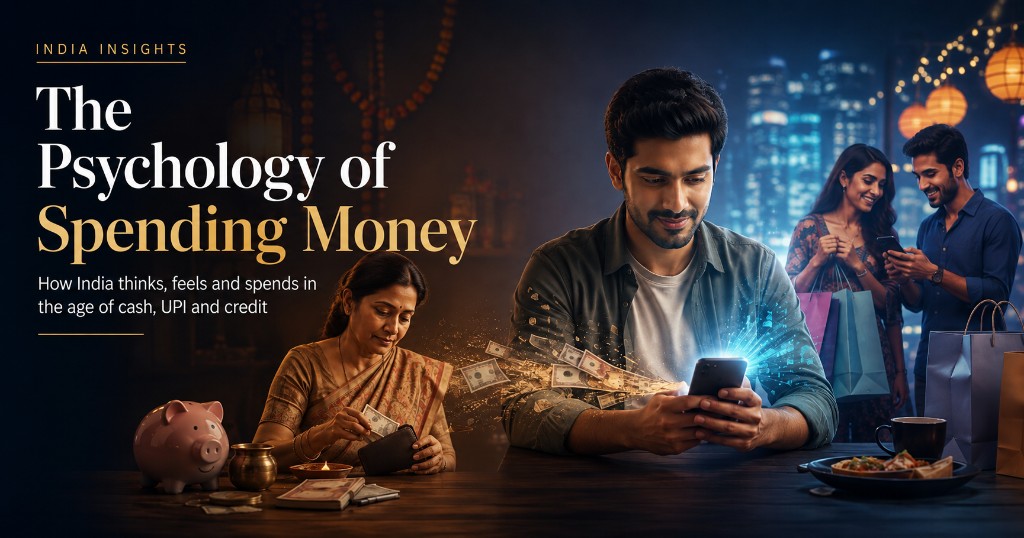
The Psychology of Spending Money in India
India's spending story is not simply that consumers are becoming more consumerist. Three forces are interacting at once: rising consumption capacity, dramatically lower payment friction, and deeply embedded social incentives around family, identity and visible consumption.
The result is a consumer who may behave very differently depending on income security, rural or urban location, festival timing, payment method, and whether a purchase is private utility or socially visible. In India, spending is increasingly determined not only by what people can afford, but by what money feels like at the moment of purchase.
- Monthly per capita: Rural MPCE — HCES 2023-24
- Monthly per capita: Urban MPCE — 70% above rural
- Rural budget: Food share — 40% in urban India
- Transactions: UPI (May 26) — ₹29.9 lakh crore value
- Of GNDI: Net saving — Down from 11.6% in 2020-21
The Indian Spending Map
NSO's Household Consumption Expenditure Survey remains the best national benchmark. Average monthly per-capita consumption reached ₹4,122 in rural India and ₹6,996 in urban India in 2023-24. In real 2011-12 prices, that is ₹2,079 rural and ₹3,632 urban — roughly 3.5% real growth over 2022-23 in both sectors.
The nominal urban-rural gap has narrowed from 84% in 2011-12 to 70% in 2023-24, but it remains economically substantial. Food still consumes about 47% of the rural budget versus 40% urban, which means inflation and income volatility do not merely reduce purchasing power — they change the psychological allocation of money by protecting necessities and squeezing discretionary mental accounts first.
- ₹1,430: 2011-12
- ₹3,773: 2022-23
- ₹4,122: 2023-24
Bars show rural MPCE. Urban consumption followed a parallel path — from ₹2,630 in 2011-12 to ₹6,459 in 2022-23 and ₹6,996 in 2023-24. The long gap between survey years means this should not be read as a smooth annual series, but the direction is clear: consumption capacity has risen, unevenly, across India.
- ₹7,606: Urban salaried
- ₹6,595: Urban self-employed
- ₹5,005: Rural regular non-farm wage
- ₹3,653: Rural casual labour
Regional differences are too large for one "Indian consumer" average to be commercially useful. Rural MPCE in 2023-24 ranged from ₹2,946 in Jharkhand to ₹6,611 in Kerala; urban MPCE from ₹5,393 in Jharkhand to ₹8,978 in Telangana. Kerala's urban-rural gap was only 18%; Jharkhand's was 83%. NIQ data also show rural FMCG volume growth outpacing urban for eight consecutive quarters through Q4 2025 — momentum is real even where absolute MPCE is lower.
What Actually Drives Indians to Spend
Behavioural research and consumption data point to seven overlapping mechanisms. They interact rather than operate in isolation — which is why the same household can be cautious on groceries and expansive during Diwali.
- Status: Visible consumption is part of utility, not just vanity — CMIE panel research finds conspicuous categories account for roughly 9–10% of expenditure — with lower permanent-income quartiles often spending more on visible items than the richest quartile.
- Festivals: Special occasions rewrite the household budget — ₹20,000 labelled "Diwali budget" is psychologically different from ₹20,000 in the ordinary monthly account — even though money is fungible.
- Digital payments: Digital money can feel less expensive than cash — A demonetisation natural experiment covering nearly 925,000 consumers found that moving towards digital payment increased spending — persisting after cash returned, especially on temptation goods.
- Present bias: ₹4,000 per month feels smaller than ₹48,000 upfront — 8.2% of a large 2017 financial-inclusion sample were classified present-biased — saving less and borrowing more. EMI framing exploits the same gap.
- Income security: Stability matters almost as much as income level — Households with weaker balance sheets cut durable purchases far more sharply than food or medicine when uncertainty rises.
- Inflation: Scarcity reshapes mental accounts — When food takes 47% of a rural budget, price shocks squeeze discretionary room first. NIQ data show consumers shifting to smaller packs as prices rise.
- Reference groups: Social comparison no longer stops at the neighbourhood — Industry research estimates millions of creators and Gen Z cohorts influence hundreds of billions of dollars in consumption — expanding aspirational reference points digitally.
- Capacity — Income, job security and inflation set what feels affordable.
- Identity & status — Family, peers and caste/class context add social value to some purchases.
- Mental accounts — Festivals, weddings and EMIs label money into separate psychological buckets.
- Payment friction — UPI and cards can reduce the pain of paying; credit moves cost into the future.
- Decision — Essentials, discretionary items, experiences or durables — spend now, defer, save or borrow.
Three Behaviours in Action
- Consumers tracked: Demonetisation payment experiment — 171 supermarkets, 21 districts, 5 states
- Relative spending lift: Cash-dependent → digital — 25th to 75th percentile of prior cash use
- Face makeup buyers: Urban beauty panel — ₹1,120 crore over 10 months — Kantar
- Online-only beauty: Omnichannel reality — Most still blend physical try-before-buy with digital
The festival and wedding budget illustrates social signalling: a wedding outfit or hospitality expense purchases reputation and reciprocity, not only private utility. The demonetisation study offers rare causal evidence that changing how money is represented — without proportionately changing resources — can change purchasing behaviour. Beauty and cosmetics show how identity, convenience and physical trial coexist in the same category.
What Changes When Payment Friction Disappears
NPCI recorded 23.20 billion UPI transactions worth ₹29.90 lakh crore in May 2026 alone. That does not mean UPI causes overspending, nor is transaction value the same as consumption. It does mean a psychological mechanism affecting payment salience now operates on an unprecedented transaction base.
An additional 10 percentage points of pre-shock cash dependence was associated with a 2.94-percentage-point increase in digital-payment use and a 2.38% increase in monthly spending in the supermarket study. The estimate is a local treatment effect — not a number to extrapolate to every UPI user — but the direction is clear.
Pain of paying ↓ → salience of cost ↓ → spending can rise without income rising
Implications for Households, Firms and Policy
The policy challenge is no longer just financial literacy. It is designing environments that account for predictable human biases while preserving the convenience India has rightly built.
- Lenders: Show total rupees repayable — not just the EMI — Total obligations and tenure beside every instalment counters present bias and price partitioning.
- UPI apps: Restore selective payment salience — Opt-in spending meters, category budgets and brief confirmations on high-value discretionary purchases can help without killing convenience.
- Households: Build festival sinking funds before social pressure peaks — Automated pre-commitment saving months before Diwali or wedding season moves the intervention ahead of present bias.
- Data: Track your categories, not national averages — Knowing whether groceries, dining or subscriptions moved matters more than a macro consumption statistic for personal decisions.
The Larger Conclusion
The most defensible conclusion is not that Indians are irrational spenders. Indian consumption is unusually context-dependent. Relatively constrained budgets coexist with strong social-reference systems. Ubiquitous digital payments coexist with weaker payment salience. Aspirational digital culture coexists with substantial regional and income inequality.
Household net financial saving fell from 11.6% of GNDI in 2020-21 to 5.2% in 2022-23 as pandemic-era excess savings were drawn down. That does not prove behavioural overspending. But alongside easier payment, expanding digital commerce and consumption credit, financial-health-aware choice architecture matters more than ever.
Commerce is making spending progressively easier. Good financial decisions still require feeling the future consequences of spending today.
The winners — regulators, banks, fintechs and households — will be those that preserve convenience without systematically exploiting the disappearance of friction.