· 10 min read
How Loans Are Reshaping Household Finances in India
The New Reality of Indian Household Finance
Loans are no longer just a backup option for Indian families. They have become a central part of how households buy homes, fund education, run small businesses, manage emergencies, upgrade lifestyles, and survive income shocks.
For decades, the Indian household finance story was mostly about savings. Gold, fixed deposits, real estate, insurance policies, and informal cash savings dominated the conversation. But that picture is changing fast. India is now entering a phase where household borrowing is becoming as important as household saving.
This shift is not automatically bad. Access to formal credit can be deeply empowering. A home loan can help a family build an asset. A business loan can help a small entrepreneur expand. A crop loan can help a farmer manage working capital. A personal loan can help a household handle a medical emergency without selling assets.
But the same credit expansion also has a darker side. When loans are taken for consumption, when EMIs rise faster than income, when borrowers stack multiple unsecured loans, or when families borrow from informal lenders at high cost, credit can quietly become a financial trap.
India's household-credit story is therefore not a simple story of "more loans". It is a story of access, aspiration, formalisation, risk, and financial discipline.
India's Household Debt Is Rising
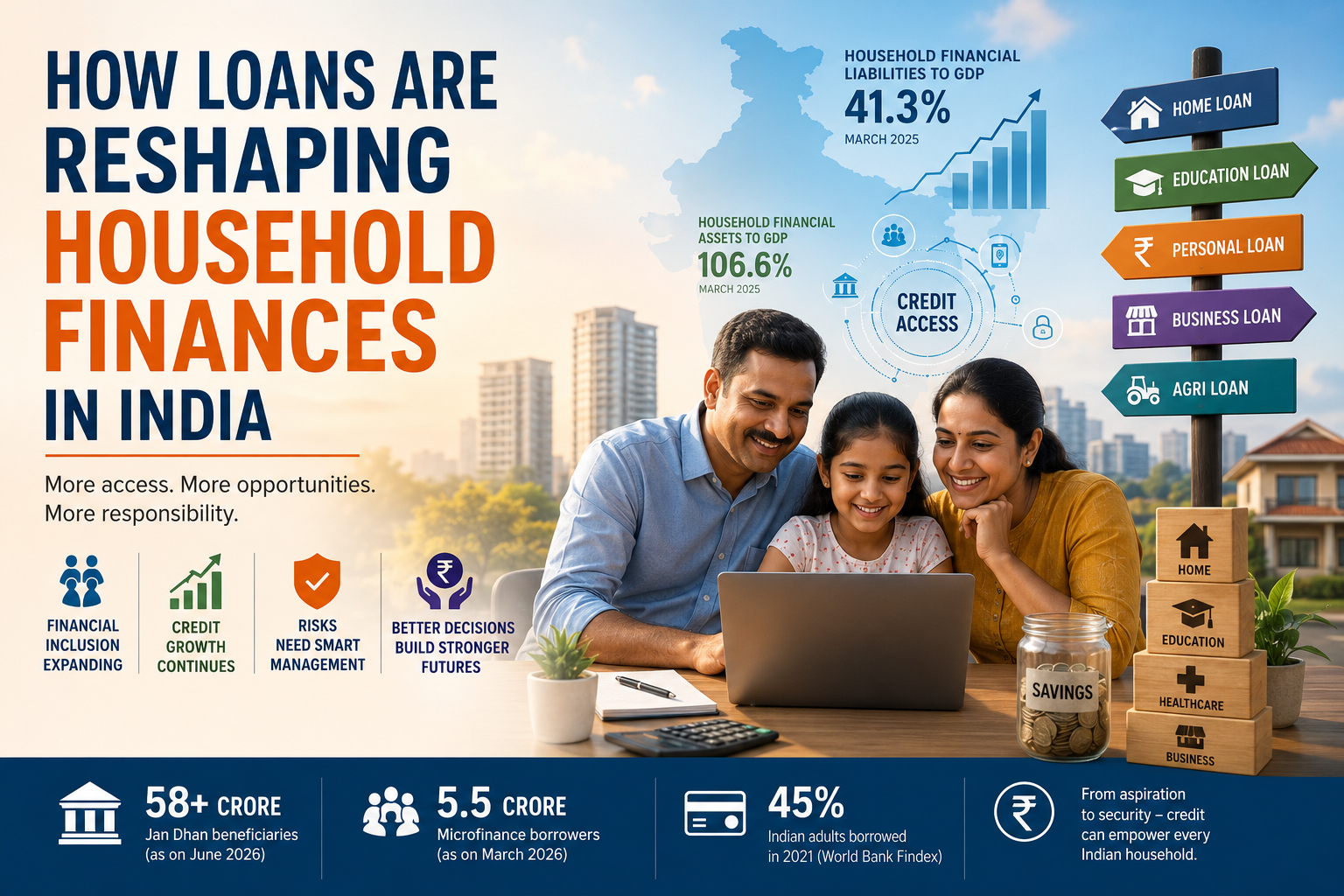
The latest data show that Indian household borrowing has increased meaningfully. Household financial liabilities stood at around 41.3% of GDP by March 2025 — a significant rise from earlier years that shows how deeply credit has entered household balance sheets.
At the same time, this does not mean India is facing a household-debt crisis at the aggregate level. Household financial assets were estimated at more than 100% of GDP, which means the overall household sector still has a sizeable asset cushion.
But averages can hide stress.
A middle-class salaried household with a home loan and stable income is very different from a lower-income family juggling personal loans, credit card dues, gold loans, and informal borrowing. On paper, both are "borrowers". In reality, their financial risk is completely different.
This is the most important point: India's household debt problem is not yet a broad macro crisis, but it is becoming a serious micro-level stress issue for specific borrower segments.
Why Indian Households Are Borrowing More
There are several reasons why loans are becoming more common in India.
- Aspirations have changed — families want better homes, education, healthcare, mobility, and lifestyles. Credit allows households to consume today and pay over time.
- Formal credit access has expanded massively — Jan Dhan accounts, Aadhaar-based KYC, UPI, credit bureaus, NBFCs, fintech lenders, and digital lending apps have made borrowing easier than ever.
- Income volatility remains high — farmers, gig workers, small business owners, and daily-wage earners often use loans to manage uneven cash flows.
- Emergencies continue to drive borrowing — medical expenses, job loss, family obligations, education fees, weddings, and business shocks push many families into debt.
- Credit has become frictionless — many personal loans, BNPL products, and app-based loans can now be accessed in minutes.
The Formalisation of Credit Is a Big Positive
One of the biggest improvements in India's financial system is the movement from informal credit to formal credit.
Pradhan Mantri Jan Dhan Yojana has brought more than 58 crore beneficiaries into the banking system, with deposits above ₹3 lakh crore. Microfinance, self-help groups, MUDRA loans, Kisan Credit Cards, NBFC loans, and fintech lending have also expanded access to credit for people who were earlier dependent on moneylenders, relatives, or local financiers.
This matters because informal credit is usually expensive, opaque, and emotionally stressful. Formal credit, when properly regulated, gives borrowers more transparency, documentation, and legal protection.
But formal credit is not automatically safe. A badly priced digital loan, a high-interest personal loan, or repeated borrowing from multiple lenders can still damage household finances.
The Biggest Risk: Unsecured Personal Loans
The fastest-growing and riskiest part of household borrowing is unsecured credit.
Unsecured personal loans, credit card dues, app-based loans, and small-ticket digital loans do not require collateral. That makes them easy to access, but also risky for both lenders and borrowers.
For borrowers, the danger is simple: these loans are often used for consumption, not asset creation. A home loan creates a house. An education loan may improve future income. A business loan may generate cash flow. But a personal loan used for lifestyle expenses, shopping, travel, or debt repayment can leave behind only EMIs.
The risk becomes worse when one loan is used to repay another. This creates a debt rollover cycle — the borrower may appear current for some time, but the household balance sheet keeps weakening.
Credit cards create a similar problem. Used responsibly, they are useful. Used carelessly, they become one of the most expensive forms of household debt. Minimum payments give temporary relief but increase long-term interest burden.
The RBI has already flagged rising stress in retail pockets such as credit cards, personal loans, microfinance, and lower-rated borrowers. This is not noise. It is a warning signal.
Microfinance: Inclusion With Stress Points
Microfinance plays a major role in India's credit ecosystem, especially for women, rural households, and low-income borrowers.
As of March 2026, the sector served around 5.5 crore unique live borrowers across 7.6 crore active loans, with portfolio outstanding of about ₹2.77 lakh crore.
At its best, microfinance helps households start small businesses, buy livestock, fund farm activities, or invest in income-generating activities. It also gives women more direct participation in household financial decisions.
But microfinance can become dangerous when borrowers have loans from multiple lenders, when repayments are not matched to cash flow, or when credit is pushed aggressively without enough income assessment.
The lesson is clear: microfinance is valuable, but only when lending discipline is strong.
Rural and Urban India Borrow Differently
Household borrowing in India is not uniform.
In rural India, indebtedness is often linked to agriculture, livestock, healthcare, consumption smoothing, weddings, social obligations, and small enterprises. Many rural households borrow smaller amounts, but a larger share of households may be indebted.
In urban India, fewer households may be indebted, but the average loan size is much higher — because urban borrowers are more likely to have housing loans, vehicle loans, business loans, education loans, and larger personal loans.
Rural India also has a much higher dependence on non-institutional credit sources — moneylenders, relatives, friends, traders, and informal financiers continue to matter significantly. This is why India cannot look at household debt only through banks and NBFCs.
Women Borrowers Are Becoming More Important
One of the most encouraging trends in Indian credit is the rise of women borrowers. Women are increasingly participating in formal credit through self-help groups, microfinance, small business loans, gold loans, and retail credit products.
When women get access to credit, the loan is often linked to household stability, small enterprise, children's education, livestock, food businesses, tailoring, retail trade, or local services.
Several bureau-based studies have also indicated that women borrowers often show strong repayment behaviour. Expanding responsible credit access to women can be economically meaningful.
The next step is not just giving loans to women — it is giving them fair pricing, transparent terms, digital literacy, repayment flexibility, and business support.
Young Indians Are Entering Credit Earlier
Gen Z and younger millennials are entering formal credit much earlier than previous generations. They use credit cards, app-based loans, consumer finance, education loans, two-wheeler loans, and digital credit products.
The positive side: young borrowers can build credit history early. A good repayment record can help them access better loans in the future.
The negative side: many young borrowers have thin credit files, unstable income, limited savings, and high exposure to lifestyle-led spending. Easy digital credit can make them feel financially stronger than they actually are.
For young Indians, the first few years of credit behaviour are extremely important. Good habits can compound positively. Bad habits can damage CIBIL scores, increase borrowing costs, and create long-term financial stress.
Loans Can Build Wealth — or Destroy Savings
The real impact of a loan depends entirely on what it is used for. Productive debt has at least one of these characteristics:
- It creates an asset
- It improves future income
- It prevents a larger financial loss
- It replaces costlier informal debt
- It supports business or livelihood activity
Destructive debt has a very different pattern:
- It funds non-essential consumption
- It carries a high interest rate
- It is taken without repayment visibility
- It is used to repay another loan
- It reduces savings every month without creating value
The same ₹1 lakh loan can be smart or dangerous depending on the borrower's income, purpose, interest rate, tenure, and repayment discipline.
The EMI Trap
The biggest practical risk for Indian households is not the loan amount. It is the EMI burden.
Many borrowers ask, "Can I get this loan?" The better question is, "Can I comfortably repay this loan without damaging my savings?"
A household may qualify for a loan because of income, credit score, or bank eligibility. But qualification does not mean affordability.
If EMIs consume too much of monthly income, the household becomes fragile. One medical bill, job loss, delayed salary, business slowdown, or family emergency can break the repayment cycle.
A healthy household should ideally keep total EMIs within a controlled share of monthly income. Once EMIs start eating into savings, the danger begins.
The most dangerous situation is when a household has no emergency fund and multiple EMIs. That is when even a small shock can force new borrowing.
Informal Borrowing: India's Hidden Debt Problem
A major part of India's household debt stress does not show up cleanly in banking data.
Many households still borrow from moneylenders, relatives, employers, shopkeepers, traders, local financiers, and community networks. This borrowing is often invisible to credit bureaus and formal financial reports.
Informal credit survives because it is fast, flexible, relationship-driven, and available when formal lenders say no. But it can also be expensive and risky. Interest rates may not be transparent. Repayment pressure can be social and emotional.
This is why financial inclusion must go beyond opening bank accounts. India needs formal credit products that are fast enough, small enough, flexible enough, and humane enough to replace informal borrowing.
What Households Should Do
For households, the rules are simple but powerful:
- Do not borrow just because credit is available
- Do not take unsecured loans for lifestyle expenses unless repayment is comfortably manageable
- Do not use one loan to repay another unless there is a clear restructuring plan
- Do not ignore your credit score
- Do not treat credit cards as free money
- Do not take gold loans casually — they are useful for short-term liquidity, not permanent working capital
- Do not compare your loan eligibility with your actual financial capacity
- Track every EMI, every due date, every interest rate, and every outstanding balance
A household that does not track its debt cannot control its debt.
Where Personal Finance Tools Can Help
Most Indian households do not fail financially because they lack intelligence. They struggle because their financial data is scattered.
Salary comes into one account. EMIs go from another. UPI spends happen across apps. Credit card bills come separately. Loan reminders sit in SMS inboxes. Subscriptions renew quietly. Insurance premiums, school fees, rent, and medical bills appear at different times.
This makes money management mentally exhausting.
Tools that automatically organise spending, reminders, EMIs, bills, and financial patterns can help households see the full picture. When people know where their money is going and what liabilities are coming up, they make better decisions.
The future of personal finance will not be only about earning more. It will be about tracking better, borrowing smarter, and staying financially aware.
Conclusion: Loans Are a Force Multiplier
Loans are neither good nor bad by default. They are a force multiplier.
When used well, loans can help Indian households build homes, educate children, grow businesses, handle shocks, and participate in the formal economy.
When used poorly, loans can reduce savings, increase stress, damage credit scores, and trap families in repayment cycles.
India's household-finance future will depend on the quality of borrowing, not just the quantity of borrowing.
The next phase of India's financial growth must be built on responsible credit, transparent lending, stronger borrower awareness, and better money tracking.
Because the real goal is not just more access to loans.
The real goal is better financial lives.