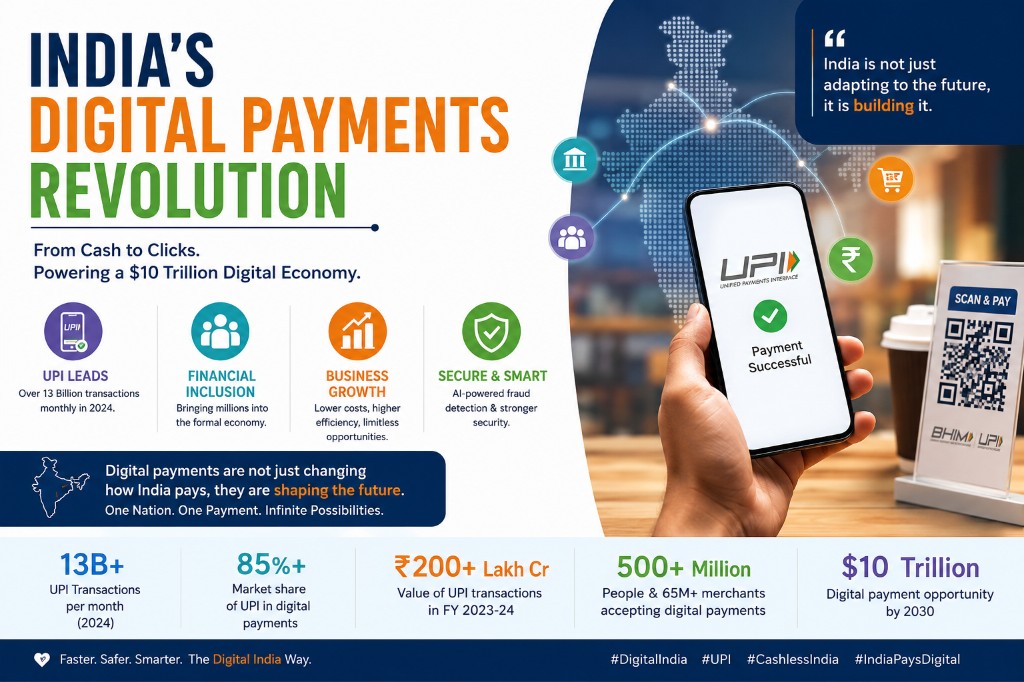
· 16 min read
India's Digital Payments Revolution: UPI, Growth and Future
India's digital payments revolution is best understood not as a single product success, but as the convergence of public digital infrastructure, regulatory sequencing, and relentless private execution.
Aadhaar created a scalable identity and authentication layer. Jan Dhan massively expanded basic bank-account ownership. NPCI built common payment rails. IMPS proved that instant interbank transfers could work at scale. UPI turned those rails into an open, app-driven protocol. And BHIM, Aadhaar-enabled payments, merchant QR, and zero-friction onboarding made digital payments usable for everyday India — not just affluent urban consumers.
The result is not merely a bigger payments market. It is a structural change in how households, merchants, governments, and fintechs move money.
By June 2026, UPI had 731 live banks, processed 22.716 billion transactions in the month, and handled ₹28.92 lakh crore in value. For FY 2025–26, official figures put UPI at 24,162 crore transactions worth more than ₹314 lakh crore, with nearly 55.49 crore users onboarded.
Digital payment transactions overall rose from 2,071 crore in FY 2017–18 to 22,831 crore in FY 2024–25, while value rose from ₹1,962 lakh crore to ₹3,509 lakh crore. UPI has become the dominant driver of that shift — accounting for around 81% of digital payment transactions in FY 2024–25.
India's payments system has moved from digitising bank transfers to embedding payments inside commerce, welfare delivery, informal retail, transport, utilities, lending, and cross-border remittances. But extraordinary scale does not mean the revolution is complete.
From Identity to Instant Payments
India's payments revolution did not begin with QR codes.
Its legal and institutional foundation was laid by the Payment and Settlement Systems Act, 2007, which gave the RBI formal authority to regulate and supervise payment systems. NPCI then emerged as the umbrella institution for retail payments. UIDAI built a national digital identity system — the first Aadhaar number was issued on 29 September 2010.
These moves created the "identity + regulated retail rails" base layer on which later innovations could sit.
The Inclusion Inflection Point
PMJDY, launched on 28 August 2014, dramatically widened access to bank accounts. More than 55 crore PMJDY accounts have been opened — 56.2% held by women, and 66.6% located in rural and semi-urban areas.
That matters because digital payments cannot scale where there is no account to move money into or out of. Aadhaar then lowered proof-of-identity friction. By 31 March 2025, UIDAI's platform had processed more than 229.33 billion authentication transactions and 22.19 billion e-KYC transactions — underscoring how identity became an operational utility rather than a one-time enrolment exercise.
Why UPI Changed the Game
UPI's arrival in 2016 transformed instant account transfers from a bank-channel feature into an open, interoperable protocol that any approved app could use.
The demonetisation shock of November 2016 accelerated experimentation. Official communication later noted a 584% increase in UPI transactions and a 1,352% increase in Aadhaar-based payments in the period after demonetisation. Academic assessments have since concluded that demonetisation had limited success on several of its stated objectives and imposed real output and employment costs.
The balanced reading is this: demonetisation did not "create" India's digital payments revolution, but it undeniably compressed consumer and merchant trial cycles during a moment when the rails were ready.
Key Milestones Along the Way
- 2007 — PSS Act gives RBI statutory authority over payment systems
- 2008 — NPCI established as the retail-payments umbrella institution
- 2010 — First Aadhaar number issued
- 2014 — PMJDY launched, expanding low-friction bank-account access
- 2016 — UPI launched; demonetisation announced; BHIM launched
- 2017 — BHIM Aadhaar Pay enables biometric merchant payments
- 2018–19 — Payment-system data localisation clarified
- 2019–20 — NEFT and RTGS become 24x7
- 2023 — UPI–PayNow linkage goes live; DPDP Act enacted
- FY 2025–26 — UPI crosses 24,162 crore annual transactions and ₹314 lakh crore in value
The historical lesson is straightforward. India did not succeed because it picked one winning private firm. It succeeded because it built a public core and allowed private firms to compete fiercely on top of it. That is closer to a digital-market utility model than to a classic closed-bank or closed-card-network model.
Rails, Architecture and How Money Moves
India's payments stack is not a single system. It is a layered portfolio of rails with different economics and use cases.
RBI directly operates RTGS and NEFT. NPCI operates much of the mass retail layer — including IMPS, UPI, AePS, NACH, RuPay, and BBPS. The critical architectural choice was to preserve interoperability rather than let each bank or wallet build a closed loop. That keeps switching costs low for users and merchants, and pushes competition into customer experience, distribution, and adjacent financial products.
Major Payment Rails at a Glance
- RTGS (RBI) — Real-time gross settlement for high-value transfers; minimum ₹2 lakh; 24x7
- NEFT (RBI) — Batch-based retail transfers; no floor or ceiling under RBI rules; 24x7
- IMPS (NPCI) — Instant interbank transfers up to ₹5 lakh; the precursor rail for UPI
- UPI (NPCI) — Open interoperable protocol for everyday P2P and P2M payments, QR commerce, bills and Autopay
- AePS (NPCI) — Biometric assisted banking via BCs and micro-ATMs for last-mile inclusion
- BHIM Aadhaar Pay — Merchant acceptance using Aadhaar authentication for customers without cards or smartphones
The architecture of UPI looks simple from the outside — a QR code, UPI ID, mobile number, or bank handle. Underneath, a third-party app or bank app talks to a PSP bank, NPCI's switch routes the instruction, and the destination bank posts the credit.
The front end, the switching layer, and the account layer are separable. That is why regulatory or commercial disruption at one app does not automatically collapse the underlying rail.
Adoption, Scale and Market Structure
UPI grew from 92 crore transactions in FY 2017–18 to 18,587 crore in FY 2024–25, and then to 24,162 crore in FY 2025–26. Over the same period, total digital payments across the official DFS basket grew from 2,071 crore to 22,831 crore by FY 2024–25.
Put differently: India's payments market did not just digitise — it became overwhelmingly UPI-centred.
Where Things Stand Now
- June 2026: 22.716 billion UPI transactions worth ₹28.92 lakh crore — up from 18.39 billion and ~₹24 lakh crore in June 2025
- 731 banks live on UPI
- Nearly 55.49 crore cumulative UPI users
- India accounts for roughly 49% of global real-time payments volume
App-Layer Concentration Remains Real
Scale is not evenly distributed. In May 2026:
- PhonePe — 46.3% of UPI volume (~10.74 billion transactions)
- Google Pay — 32.7% (~7.59 billion)
- Paytm — 7.9% (~1.83 billion)
- Navi — 3.6%; super.money — 1.8%; BHIM — about 1%
The top two fell below 80% for the first time, but the top three still controlled nearly 87%. That is why NPCI's long-discussed 30% market-share cap on third-party UPI apps remains strategically important even after its repeated deferrals.
India has built an open public rail. The consumer interface layer still exhibits duopoly tendencies.
Who Is Adopting — and Who Is Still Left Out
TRAI reported 969.10 million internet subscribers at end-March 2025 — 544.76 million urban and 424.10 million rural. A Ministry of Statistics survey found that 85.5% of Indian households had at least one smartphone.
Those figures explain why UPI could leap from an urban proposition to a far broader consumer habit. Yet adoption is still stratified. Take-up remains stronger among younger, urban, higher-income, and better-educated users — even as women and smaller-town users contribute a growing share of incremental growth.
India has crossed the "proof of concept" stage. The "last mile of universality" remains unfinished.
Business Models: Scale Without Easy Profit
The most misunderstood feature of India's digital payments market is that spectacular scale has not always meant spectacular standalone profitability.
Standard UPI remains effectively zero-priced for consumers and, in practical terms, zero-MDR for standard merchant transactions. That has been excellent for adoption but difficult for direct payment-rail monetisation.
Winning business models have therefore been indirect: acquire customers cheaply through payments, then monetise through subscriptions, soundboxes, payment gateways, lending, wealth, insurance, cross-sell, advertising, or commerce.
What the Numbers Reveal About Habit Formation
Worldline's India Digital Payments Report for 1H 2025 showed UPI volumes rising 35% year on year to 106.36 billion transactions, while value rose 23% to ₹143.34 trillion. At the same time, average ticket size fell from ₹1,478 in 1H 2024 to ₹1,348 in 1H 2025.
That is exactly what one would expect when a payment system moves from occasional utility to daily low-ticket retail spending. Smaller average sizes are not a weakness — they indicate behavioural embedding in kiranas, food delivery, mobility, and household payments.
How Merchants Got Onboarded
The merchant side of India's revolution has been even more dramatic than the consumer side. UPI QR deployments more than doubled from 321.38 million in January 2024 to 678 million by June 2025, while Bharat QR moved from 6.0 million to 6.72 million and PoS terminals from 8.6 million to 11.2 million.
India did not digitise merchant acceptance mainly by pushing card terminals deeper into small retail. It did so by making acceptance almost free to install, easy to understand, and interoperable across apps. Micro-merchants became the decisive adoption engine.
Rural Uptake Through Assisted Payments
A purely smartphone-centric reading of India's payments story misses the importance of assisted models.
AePS enables rural citizens to withdraw cash using Aadhaar and biometric authentication at local access points. BHIM Aadhaar Pay supports customers without cards or smartphones. By 31 March 2024, 33 Regional Rural Banks had been onboarded to the BHIM UPI platform as issuers under a support scheme.
Rural uptake has come not only from "everyone gets a smartphone and scans QR", but also from biometrics, BC networks, and assisted interfaces for communities with weaker device access or digital confidence.
Regulation, Economics and Risk
India's regulatory framework has progressively moved from "enable digital payments" to "govern a system that is now critical national infrastructure".
At the base is the PSS Act. Payment-system data related to India must be stored in India. KYC rules continue to evolve. The Digital Personal Data Protection Act, 2023 and the subsequent 2025 rules create the broader legal framework for processing digital personal data.
What began as innovation policy has become infrastructure governance.
The Zero-Price Dilemma
No-MDR UPI has been excellent for consumer and merchant adoption. It has also created a strange incentive structure in which the most socially valuable rail is the hardest to monetise directly.
That pushes providers into indirect monetisation through devices, gateway fees, wallet economics, rewards, lending, and distribution. The current arrangement is politically popular and inclusion-friendly — but it is not a neutral market design. Over time, it favours firms with deep balance sheets, ecosystem cross-subsidies, or monetisable adjacencies.
Fraud, Trust and Soft Frictions
Fraud and consumer protection are no longer peripheral. Device binding, two-factor authentication, transaction limits and AI/ML-based fraud monitoring are now core anti-fraud tools. RBI's harmonised turnaround-time rules specify auto-reversal timelines and compensation for failed UPI and AePS transactions. Customer-liability rules require shadow reversal within 10 working days once unauthorised electronic transactions are reported.
These are signs of institutional maturity — and evidence that payment ubiquity naturally attracts increasingly industrialised fraud.
There are also softer frictions. Merchant apprehension about tax visibility has periodically produced backlash among smaller traders. Digital access still depends on connectivity, electricity, and handsets. India's digital divide has narrowed, not vanished. That is why AePS, BC networks, assisted flows, and offline innovation remain important rather than transitional.
What Comes Next
India's next chapter will not be about whether digital payments win. They already have.
The real question is what kind of digital payments system India wants by the early 2030s: one dominated by a few super-apps sitting on a public rail, or one that remains open, contestable, privacy-aware, internationally connected, and diverse in access modes.
UPI is already live in multiple countries — including Singapore, the UAE, Bhutan, Nepal, Sri Lanka, France, Mauritius and Qatar — with an expanding footprint beyond those corridors.
CBDC as Complement, Not Substitute
CBDC should be seen as a complement, not a substitute, for UPI. RBI's own framing is clear: e₹ is India's central bank digital currency, while UPI is a means of payment.
Retail CBDC onboarding is currently linked to bank accounts, which suggests that the near-term use case is selective innovation around programmability, settlement design, and specialised payment contexts — not a frontal challenge to UPI's consumer dominance. That is the correct posture. UPI has already solved everyday retail payments at massive scale; CBDC should focus where it can add unique value.
Open Banking Could Reshape the Economics
The Account Aggregator framework is showing rapid adoption, expanding beyond lending into personal financial management, underwriting and verification.
If payments were India's first digital-finance primitive, consented portable financial data may become the second. The strategic upside is better underwriting for MSMEs and households, lower paperwork, and more competition in financial services. The strategic risk is a much larger privacy and consent burden — especially for users with low digital literacy.
A Practical Policy Package
- Move from a blunt zero-price regime to a targeted, transparent subsidy model for the smallest merchants and the most inclusion-critical flows
- Treat competition at the app layer as a financial-stability issue — with a phased, predictable market-share framework
- Invest harder in offline, assisted and hybrid payment design for patchy-connectivity areas, elderly users, feature-phone users and low-literacy users
- Upgrade fraud management from a bank-by-bank operational matter to a shared national utility model
- Enforce consent standards, data minimisation and plain-language redress as payments, KYC, Aadhaar and account aggregation increasingly interlock
- Lean into cross-border UPI with discipline — prioritising corridors with remittance and travel relevance, not just symbolic linkages
The Bottom Line
India's digital payments revolution is real, durable, and globally significant. It has already changed the country's retail-payment behaviour, expanded financial inclusion, and altered how small commerce gets paid.
But the easy part is over. The next decade will be judged not by how many more QR stickers appear on shop counters, but by whether India can turn scale into a system that is sustainable, competitive, secure, and trusted by the people who now depend on it every day.
Digital payments are not just changing how India pays — they are shaping the future.
One Nation. One Payment. Infinite Possibilities.