· 11 min read
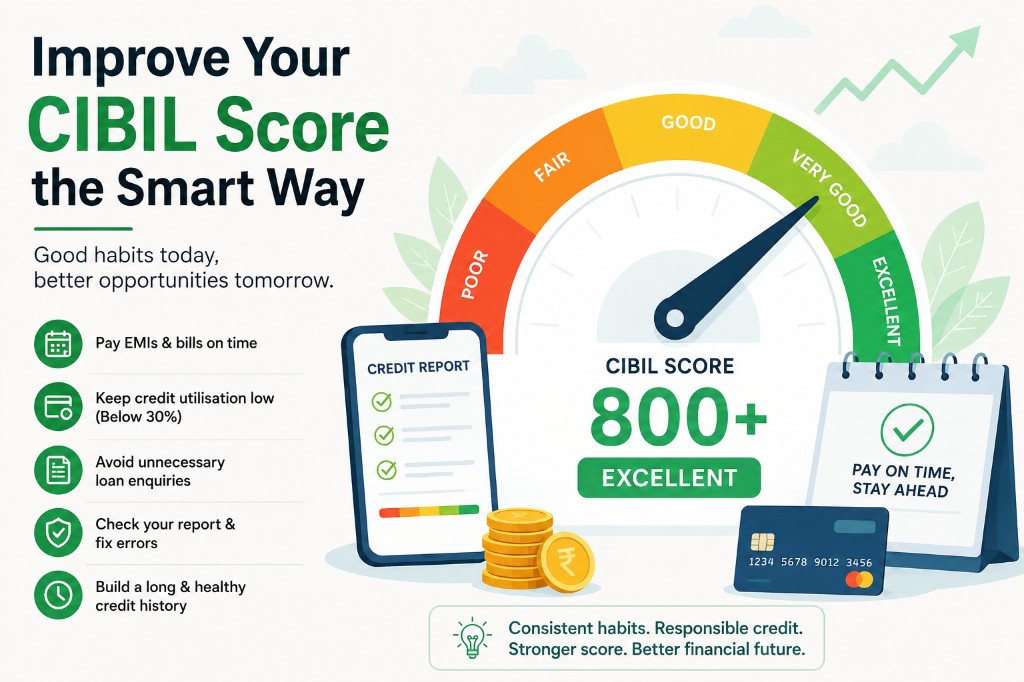
How to Improve Your CIBIL Score in India
Pay every EMI and credit-card bill on time, keep balances modest, and dispute wrong entries on your credit report. Those three steps do more to improve a CIBIL Score in India than any optimisation hack. Checking your own score does not reduce it. A 750 cutoff is not an RBI rule.
How to Improve Your CIBIL Score in India
A good CIBIL Score can improve your chances of getting a loan, raise your eligible amount, and sometimes unlock better interest rates.
It is also surrounded by misinformation. Checking your score does not reduce it. 30% utilisation is not a magical threshold. 750 is not an RBI-mandated cut-off. Credit-repair agencies cannot quickly erase genuine defaults.
The smarter approach is simpler: understand what makes your profile look risky — then fix that first.
Missed payments beat every optimisation hack. Fix the damage before polishing the details.
What Really Affects Your Score
CIBIL does not publish exact percentage weights. Its algorithm is proprietary. What it does identify are four major areas: payment history, credit utilisation, age and depth of credit history, and recent credit enquiries.
The popular internet formula claiming exact percentages is not an official Indian CIBIL formula. Priority matters more than fine-tuning.
- Missed payments — Late EMIs and card dues do the most damage
- Overdue accounts — Bring every delinquent account current
- Reporting errors — Dispute wrong data — don't build around it
- High utilisation — Especially on individual cards
- Unnecessary enquiries — Stop shopping lenders without need
1. Never Miss an EMI or Card Payment
Late payments and defaults can hurt your score more than almost anything else.
Protect yourself with operational discipline: auto-pay, a buffer in your bank account, and a reminder. Do not rely on auto-debit alone — mandates fail, and balances run short.
One missed EMI can undo months of careful optimisation.
2. Keep Credit Utilisation Under Control
Utilisation is simply your outstanding card balance divided by your available limit. Higher utilisation can signal stress. Around 30% or lower is a useful guideline before a big loan application — but it is not a magical CIBIL switch.
Utilisation = Outstanding balance ÷ Credit limit
- Healthy: ₹10,000 of ₹1 lakh
- Guideline: ₹30,000 of ₹1 lakh
- Stressed: ₹70,000 of ₹1 lakh
- Risky: ₹90,000 of ₹1 lakh
Also watch individual cards. Overall utilisation of 23% can still hide one card at 70%. Since CIBIL does not reveal exact weighting, keep both overall and per-card levels reasonably low.
3. Checking Your Own Score Does Not Hurt It
A self-enquiry is harmless. What can matter is repeatedly applying for new loans and cards.
Checking CIBIL five times is not the same as applying to five lenders. The first is awareness. The second can look credit-hungry.
4. There Is No Fixed "Points Lost Per Enquiry"
Claims like "every enquiry costs exactly 5 points" have no official CIBIL table behind them.
What matters is the pattern: apply, get rejected, apply again, then chase another card. Apply selectively — especially in a short window.
5. Salary and Savings Do Not Directly Raise CIBIL
₹25 lakh in FDs and a strong salary do not automatically produce a high CIBIL Score. Your score mainly reflects borrowing and repayment history.
Income helps underwriting. It is not the same as credit behaviour.
CIBIL Score ≠ Income · CIBIL Score ≠ Net worth · CIBIL Score ≈ your credit track record
6. Minimum Due Is Not a Long-Term Strategy
Paying only the minimum can avoid an immediate missed payment — while you still carry most of the debt, pay high interest, and keep utilisation elevated.
Whenever possible, pay the full statement. You do not need to carry a balance or pay card interest to build a good score.
7. "Settled" Is Not "Closed"
If a lender accepted less than the full amount, the account may be reported as settled. Future lenders often view that negatively.
Where practical: contact the lender, confirm remaining dues and reporting, pay in full, get an NOC, then verify your updated report. Paying up does not erase genuine past late payments — but it can improve how the account stands today.
8. Fix Reporting Errors First
Sometimes the fastest legitimate improvement is correcting bad data: loans that aren't yours, wrong late marks, duplicate accounts, closed loans shown as active, wrong limits, or unauthorised enquiries.
Dispute errors rather than building a score around them. RBI's credit-information framework provides a 30-calendar-day resolution timeline for qualifying complaints, with compensation for eligible delays.
9. 750 Matters — But It Is Not Universal
There is no RBI rule forcing lenders to reject everyone below 750. Many prefer 750+ for unsecured credit, yet they also weigh salary, existing EMIs, stability, loan size, collateral, and internal models.
A borrower with 730 and strong income may get credit while someone with 780 and heavy existing debt may not.
- Below 650: Repair territory
- 650–699: Fair / borderline
- 700–749: Generally good
- 750–799: Strong
- 800+: Excellent
10. Don't Borrow Just for "Credit Mix"
Yes, CIBIL considers the type and history of credit. No, taking a ₹2 lakh personal loan at 15% only to "improve mix" is rarely worth it.
Use credit products for genuine needs — not to manipulate a score.
How Quickly Can It Improve?
Anyone promising "+100 points in 30 days" without reading your report deserves scepticism. The same action helps two borrowers differently.
Cutting utilisation from 90% to 10% can move the needle if utilisation is your only weakness. It helps far less if you also have overdue loans, settled accounts, and a trail of recent applications.
TransUnion CIBIL research on credit improvers found average gains of about 22 points overall — and about 27 points for early-credit-journey consumers — after roughly a year. That is observational data, not a guarantee.
Real improvement usually happens over months, not days.
Myths vs Reality
- Myth: Checking your CIBIL reduces your score — Reality: False — self-enquiries are harmless
- Myth: 30% utilisation is an exact scoring threshold — Reality: It's a guideline, not a switch
- Myth: Every enquiry costs exactly 5 points — Reality: No official points table exists
- Myth: Salary automatically increases CIBIL — Reality: Score reflects credit behaviour, not income
- Myth: Carrying card debt builds credit — Reality: Pay in full — interest is not required
- Myth: Settled means closed — Reality: Settled can still look negative to lenders
- Myth: 750 is an RBI-required minimum — Reality: Lenders set their own policies
- Myth: More loans always improve credit mix — Reality: Unnecessary debt is expensive theatre
A Practical Improvement Plan
Skip the hacks. Follow this order.
- Download your full CIBIL Report — Read every account, enquiry, and late mark
- Stop all new late payments — Auto-pay + buffer + reminder
- Bring overdue accounts current — Clear delinquencies before optimisation
- Dispute genuine reporting errors — Fix wrong data at the source
- Reduce high card utilisation — Overall and per-card
- Pause unnecessary applications — No speculative loan or card shopping
- Resolve settled or written-off accounts — Where financially practical
- Keep older useful accounts healthy — Depth of history still matters
- Stay clean for 6–12 months — Good behaviour needs time to become history
Final Takeaway
Improving your CIBIL Score is mostly proof that you can handle credit responsibly: borrow within capacity, pay on time, keep balances reasonable, avoid unnecessary applications, correct inaccurate information, and give good behaviour time to show up in your history.
Never pay unnecessary interest or take unnecessary debt purely to chase points.
A CIBIL Score should help improve your financial life.
Your financial life should not revolve around improving your CIBIL Score.