· 14 min read
How Much Emergency Fund Do Indians Need
Indians are often told to keep “three to six months of expenses” as an emergency fund.
That advice is useful — but incomplete. It rarely says what counts as expenses, what official guidance actually states, or why medical shocks and irregular income change the maths in India.
An emergency fund is not an investment goal. It is a liquid buffer that stops one shock from becoming permanent debt.
What Official Guidance Actually Says
The Reserve Bank of India’s National Strategy for Financial Inclusion (NSFI) 2025–30 frames financial security partly as the “ability to meet any contingency.”
Under that heading, it lists regular liquid savings for at least two months’ average household expenses, alongside longer-term physical or financial assets.
That two-month figure is best read as a national inclusion floor — a minimum resilience target for households entering the formal system — not as the ideal corpus for every urban dual-income family with EMIs and children.
- Liquid savings: RBI floor — Average household expenses
- Financial security: Purpose — Ability to meet shocks
- Physical / financial assets: Also needed — Beyond the liquid layer
- Months essentials: Practical target — Most working households
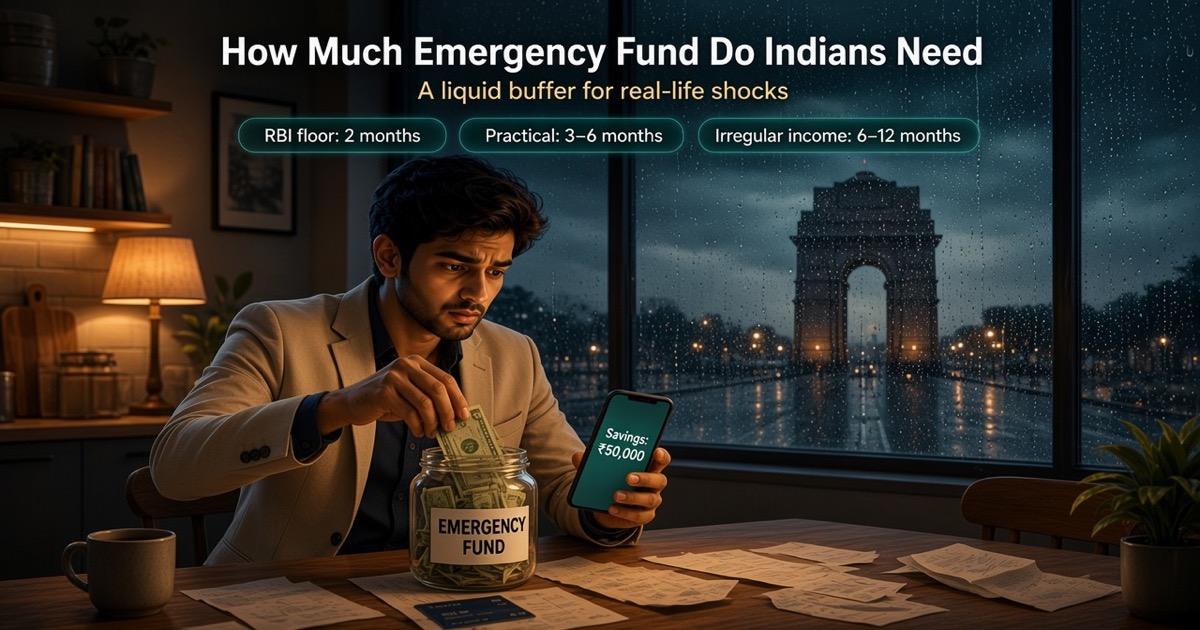
Use the RBI floor as the starting line. Use three to six months of essential expenses as the practical target. Use six to twelve months when income is irregular or you are the sole earner.
Why India Needs a Dedicated Buffer
Three structural facts make emergency savings especially important in India.
1. Medical bills still hit household cash
MoSPI’s Survey on Household Social Consumption: Health (2025 results reported by PIB) estimates average out-of-pocket medical expenditure per hospitalisation case (excluding childbirth) at about ₹34,064 nationally — ₹31,484 rural and ₹38,688 urban.
The median is lower at about ₹11,285, which means many cases are smaller — but the average is pulled up by expensive episodes.
By facility type:
- Public hospitals: average about ₹6,631 (median about ₹1,100)
- Private hospitals (including government-empanelled): average about ₹50,508 (median about ₹24,000)
- Charitable / trust / NGO hospitals: average about ₹39,530
- Average OOP: Public hospital — Median ≈ ₹1,100
- Average OOP: Private hospital — Median ≈ ₹24,000
Insurance coverage has improved — rural coverage rose from about 14% in 2017–18 to about 47% in 2025; urban from about 19% to about 44%. Coverage still leaves gaps: deductibles, exclusions, consumables, room-rent caps, travel, attendant costs and income lost during illness.
Insurance and an emergency fund solve different problems. One reimburses or cashlessly settles eligible treatment. The other keeps the household running when cash is needed today.
2. Urban job risk is higher than the headline rate suggests
PLFS data for calendar year 2025 put the usual-status unemployment rate at 3.1% overall for persons aged 15+, with rural at 2.4% and urban at 4.8%. Urban female unemployment was about 6.4%.
Youth unemployment remains much higher. In more recent Current Weekly Status bulletins, urban unemployment has hovered near the mid-to-high 6% range.
The point for emergency planning is not the national average. It is how long your household can survive if the primary earner’s income pauses for a few months — especially in cities where rent and EMIs do not pause.
3. Households save — but not always in liquid form
RBI’s Annual Report shows household-sector saving remained substantial in FY 2024–25: about 21.3% of GNDI, with net household financial saving at 7.0% of GNDI.
Macro saving does not mean every family has a usable cash buffer. Much household wealth sits in housing, gold, EPF/PPF and market investments that are hard or costly to tap in a week. Emergency money must be liquid by design.
The Only Formula That Matters
Forget vague “months of salary.” Build from essentials.
Emergency fund = Essential monthly expenses × Number of months
Count only what you must keep paying if income stops:
- Rent or home-loan EMI
- Groceries and cooking fuel
- Electricity, water, internet, school fees
- Medicines and unavoidable healthcare
- Insurance premiums due in the buffer window
- Minimum loan / card payments required to avoid default
- Essential transport and dependant support
Leave out dining out, shopping, holidays, gadgets, discretionary SIPs and “nice to have” subscriptions. You can restart those after income returns.
How Many Months Do Indians Need?
Use this India-specific ladder:
- Floor: 2 months — RBI NSFI contingency minimum — start here if you have almost nothing
- Stable salaried: 3–4 months — Dual income, low EMIs, strong employability
- Typical family: 5–6 months — Children, parents, rent/EMI, or single earner
- Same-sector couple: ~6 months — Both jobs exposed to the same industry shock
- Irregular income: 6–12 months — Freelancer, business owner, commission, seasonal work
- High fixed costs: add a month — Metro rent, large EMIs, or weak health cover
Worked Examples (Essential Expenses Only)
- ₹40,000 × 4 months: Solo salaried — Stable job, few dependants
- ₹90,000 × 6 months: Family + EMI — Kids / parents / housing EMI
- ₹60,000 × 9 months: Freelancer — Irregular cash flow
- Immediate starter: Mini-fund first — Before the full target
HCES 2023–24 puts average monthly per capita consumption near ₹4,122 rural and ₹6,996 urban. Household emergency targets are still personal: multiply your household’s essential burn rate, not a national average.
Where to Keep the Money
Priority order: safety and access first, return second.
- Cash at home — 3–7 days of essentials for outages — not large stashes
- Separate savings account — ~1 month instantly available; label it Emergency Only
- Sweep-in / short FDs — Better yield than plain savings; break only what you need
- Liquid funds (optional layer) — For the outer months — not the first rupee you may need tonight
Do not park the primary emergency fund in equity SIPs, stocks, PPF or EPF. Those can be long-term backups. They are not same-day contingency money.
Remember DICGC deposit insurance generally covers up to ₹5 lakh per depositor per bank (principal + interest).
What Counts as a Real Emergency
Use the fund when the expense is unexpected, essential and urgent:
- Job loss or delayed client payments
- Hospitalisation / urgent treatment cash needs
- Critical home or work-vehicle repairs
- Keeping rent, EMI or school fees current during an income pause
- Urgent family-crisis travel
Do not use it for holidays, weddings, gadgets, sale shopping, festival gifts or “can’t miss” market dips.
How to Build It Without Waiting for a Perfect Salary
- Calculate essentials from 3 months of data — Separate needs from wants — SMS-based tracking helps
- Hit the mini-fund fast — ₹25,000–₹50,000 or one month of essentials
- Automate the transfer on payday — Treat it like an EMI to yourself
- Park windfalls — Bonus, tax refund, freelance spikes
- Climb to your month target — 2 → 3 → 6 (or 9–12 if income is irregular)
- Rebuild after every use — Using it is success — leaving it empty is the risk
Inly Perspective: Know Your Essential Burn Rate
Most people fail emergency planning at step one: they do not know last month’s essential spend.
Inly helps you see spending, EMIs, subscriptions and recurring obligations from the financial SMS trail you already receive — so you can answer:
- What are my fixed monthly outflows?
- How much goes to EMIs versus discretionary spends?
- Which subscriptions can I pause while rebuilding a buffer?
- What payments are due in the next 7 days if income stops?
You cannot size a buffer for a number you have never measured.
Bharat’s Money Lens. Understand Before You Spend.
Frequently Asked Questions
Short answers grounded in the sources above.
Is 3–6 months an RBI rule?
No. RBI’s NSFI 2025–30 cites liquid savings of at least two months’ average household expenses as part of contingency readiness. Three to six months is a practical household target above that floor.
Should health insurance replace an emergency fund?
No. Even with rising coverage, hospitalisation still produces out-of-pocket costs — especially in private care, where the 2025 survey average was about ₹50,508 per case. Insurance and cash buffers complement each other.
Is my credit-card limit an emergency fund?
No. It is expensive debt. A true emergency fund is your money, available without interest compounding against you.
Can SIPs count as emergency savings?
Not as the first line. Equity values can fall exactly when you need cash. Keep the emergency layer in savings, short deposits or suitable liquid instruments; let SIPs stay long-term.
Final Takeaway
How much emergency fund do Indians need?
• At least two months of average household expenses as a liquid floor (RBI NSFI framing) • Typically three to six months of essential expenses for salaried and family households • Six to twelve months when income is irregular or concentrated in one earner
Start with a mini-fund this month. Automate the climb. Keep it liquid. Rebuild after every use.
An emergency fund will not make you rich. It keeps a bad month from rewriting the next five years.
Understand your money before you spend it.
Download Inly and get a clearer view of your spending, EMIs, subscriptions and financial patterns — in one place.
Inly — Bharat’s Money Lens. Understand Before You Spend.
Sources: Reserve Bank of India, National Strategy for Financial Inclusion 2025–30 (liquid savings of at least two months’ average household expenses under contingency / financial security); MoSPI / PIB reporting on Survey on Household Social Consumption: Health 2025 (hospitalisation OOP averages/medians; public vs private; insurance coverage 2017–18 vs 2025); PLFS / MoSPI employment indicators for 2025 and later CWS bulletins (urban–rural unemployment context); RBI Annual Report 2024–25 (household saving as % of GNDI); MoSPI HCES 2023–24 (MPCE context). Household examples are illustrative. This is educational content, not personalised financial, investment, insurance or tax advice.