· 15 min read
Credit History vs Credit Score: What Indians Must Know
Most Indians talk about their “CIBIL score” as if that three-digit number were the whole credit file.
It is not.
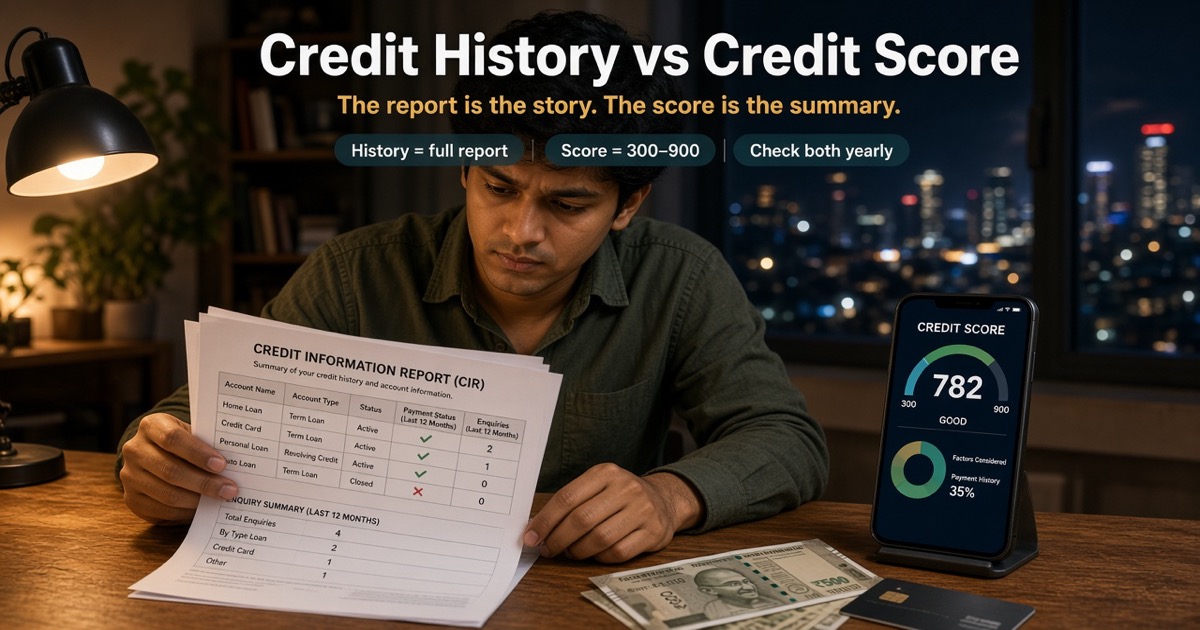
Your credit score is a compressed risk signal. Your credit history — the Credit Information Report (CIR) — is the detailed record of accounts, balances, payment behaviour and enquiries that produced that signal. Lenders look at both. Fixating on the number while ignoring the report is how people miss closed loans still marked active, wrong late payments, or a thin file that scores poorly for lack of data.
Credit history is the story. Credit score is the headline. Underwriters read the story.
The One-Line Difference
Keep this distinction clear:
- The full report: Credit history (CIR) — Accounts, dues, DPD, enquiries, status
- The summary: Credit score — Proprietary risk number from that report
TransUnion CIBIL describes its score as a three-digit numeric summary of your credit history, derived mainly from the Accounts and Enquiries sections of your CIBIL Report, on a 300–900 scale. Higher is generally stronger for loan review — but the decision to lend still belongs to the bank or NBFC, not the bureau.
Who Keeps Your Credit File in India
India has four RBI-registered Credit Information Companies (CICs) under the Credit Information Companies (Regulation) Act, 2005:
- TransUnion CIBIL Limited
- Experian Credit Information Company of India
- Equifax Credit Information Services
- CRIF High Mark Credit Information Services
Banks and other credit institutions report borrower data to these CICs. Each CIC builds its own report and score model. That is why your “Experian score” and “CIBIL score” can differ even when the underlying life is the same — data timing, which lenders report how often, and model design are not identical.
RBI’s Credit Information Companies Directions, 2025 require CICs to calibrate consumer credit scores on a common 300–900 scale so households can interpret bands more consistently across bureaus.
- Bureaus: Registered CICs — CIBIL, Experian, Equifax, CRIF
- Common band: Score scale — Per RBI CIC Directions 2025
- Per CIC: Free report — FFCR including score (Jan–Dec)
- Resolution: Dispute clock — Then ₹100/day compensation if delayed
What Credit History Actually Contains
Your CIR is not a personality test. It is a structured ledger of credit relationships lenders have reported. Typical sections include:
- Personal identifiers used for matching (name, date of birth, PAN, address, contact — as reported)
- Account / tradeline list: loans and cards, lender type, open/closed status, limits, outstanding amounts
- Payment history / days past due (DPD): whether EMIs and card dues were on time
- Asset classification style flags where reported (standard, overdue, written-off, settled — wording varies)
- Enquiry section: who pulled your file and when (especially hard enquiries tied to applications)
- Sometimes related-party / joint / guaranteed exposure notes that affect shared liability
This is why two borrowers with the same score can look very different on a desk. One may have a clean five-year home-loan trail. Another may have the same score after a recent recovery from high card utilisation. The history explains the path; the score only ranks the present risk snapshot.
What a Credit Score Is — and Is Not
A bureau score answers one narrow question: based on reported credit behaviour, how risky does this borrower look relative to others in the model?
It is not:
- Your salary, savings, FD balance or net worth
- A guarantee of loan approval
- An RBI-mandated pass/fail cut-off (lenders set their own policies)
- Proof that every line on the report is correct — you still verify the CIR
CIBIL’s public guidance stresses payment behaviour, utilisation, credit mix and enquiry patterns as major drivers — without publishing an official percentage formula. Treat viral “exact weight” charts as unofficial simplifications, not regulatory tables.
How Score and History Work Together for Lenders
In practice, many lenders use a two-step habit:
- Screen with the score — Fast filter — very low scores may stop further review
- Read the CIR — Check recent lates, settlements, write-offs, enquiry spikes
- Layer income & EMI — Salary, FOIR, existing loans, collateral, product rules
- Decide terms — Approve, price higher, shrink limit, ask for security, or decline
CIBIL notes that a large share of sanctioned loans go to consumers scoring above 750 — useful context, not a legal floor. A borrower at 730 with clean recent history and low FOIR can still beat a 780 with heavy unsecured debt and five fresh enquiries.
When You Have History but No Score (NH / NA)
If the bureau cannot generate a numeric score, reports may show NH (No Hit / No History) or NA (Not Applicable). CIBIL describes a No Hit as insufficient credit activity to produce a Score & Report from the details submitted.
That is not a “bad score.” It is a blank or thin file. Lenders then lean harder on income proofs, bank statements, Account Aggregator cash-flow data, employment stability and product-specific rules — or they hesitate because there is no repayment trail to trust.
- Myth: Myth: NH means you are a defaulter — Reality: Reality: It usually means too little reported credit activity to score
- Myth: Myth: High salary automatically creates a score — Reality: Reality: Scores need reported loans/cards and repayment behaviour
- Myth: Myth: Avoiding all credit forever is safest — Reality: Reality: No history can slow approvals when you later need a home loan
Score Bands Indians Actually Use
Bands are marketing shorthand, not RBI law. A practical reading for household planning:
- NH / NA: No usable numeric score yet
- Below 650: Repair / high friction
- 650–699: Fair / cautious pricing
- 700–749: Generally workable
- 750–799: Strong for many unsecured products
- 800+: Excellent band
Why Your Score Can Move While History Looks “the Same”
People often say “nothing changed” when the score drops. Something on the report almost always did:
- A card statement date captured a high outstanding → utilisation spiked
- A lender reported a late payment or DPD bucket you missed noticing
- A new hard enquiry landed after an app-based loan check
- An old closed account finally aged off — or a duplicate finally got fixed
- Another CIC updated faster than the one you usually check
The score is volatile because it is a model output. The history is the audit trail. When the number moves, open the report first.
How to Check Both Without Getting Scammed
Under RBI’s CIC Directions, each CIC must give individuals whose score is available one Free Full Credit Report (FFCR) including credit score, once in a calendar year (January–December), after authentication. Contents must match the most detailed version provided to credit institutions, and CICs must surface the FFCR link prominently on their homepage.
Practical habit:
- Pull FFCR from each CIC you can — One free full report + score per bureau per calendar year
- Read accounts before the score — Wrong late marks beat any optimisation tip
- Dispute errors in writing — 30-calendar-day resolution window; ₹100/day if delayed
- Separate soft checks from applications — Self-monitoring ≠ spraying loan apps everywhere
If a complaint about incorrect credit information is not resolved within 30 calendar days of filing with a CI or CIC, RBI’s framework entitles eligible complainants to compensation of ₹100 per calendar day of delay, apportioned between responsible institutions — with credit institutions generally needing to push corrections within 21 days inside that overall clock.
What to Fix First: History Bugs or Score Optics
Order of operations matters more than hacks:
- Correct false report data — Not your loan, wrong DPD, duplicate, closed-as-active
- Bring every account current — Clear overdue EMIs and card dues before fine-tuning
- Lower utilisation on cards — Pay down balances; watch per-card spikes before big applications
- Pause unnecessary applications — Stop enquiry stacking while the file heals
- Then pursue score improvement habits — On-time payments, modest limits use, patient ageing of clean history
For a deeper playbook on raising the number once the report is clean, see our guide on improving your CIBIL Score in India. This article’s job is different: stop treating the score as the file.
Worked Scenarios
- Score: Clean long file — 5-yr home loan, on-time, low cards
- Score: Recent stress — Caught up after 2 late EMIs last year
- Score: Settled account — History shows settlement — lenders dig in
- No score: Thin / NH — Income strong, bureau blank
Inly Perspective: Behaviour Beats the Badge
A bureau score is a lagging label for repayment behaviour. The leading indicators live in your monthly money flow: EMI dates, card statements, auto-debit failures, and spending that forces minimum dues.
Inly helps you see the operational side — UPI, SMS and recurring obligations — so you can answer:
- Which EMIs and card dues land in the next 7–14 days?
- Am I running card balances that will print as high utilisation?
- Which subscriptions and EMIs compete for the same payday?
- Did a payment fail before the lender reports a late mark?
Inly Score is an in-app awareness metric. It is not a CIBIL score, not a bureau CIR, and not a substitute for your Free Full Credit Report.
Bharat’s Money Lens. Understand Before You Spend.
Frequently Asked Questions
Is credit history the same as CIBIL score?
No. Credit history is the detailed CIR. The CIBIL Score (or another CIC’s score) is a three-digit summary calculated from that history. You need both: the number for a quick read, the report for truth.
Do all four bureaus show the same history?
Not always line-for-line. Reporting lags and membership differ. Checking more than one CIC’s free annual report is wise before a large loan.
Does checking my own score hurt my history?
Self-access / consumer monitoring is not the same as a lender hard enquiry from a loan application. What can look risky is applying to many lenders in a short window.
Can a high score hide a bad history line?
A strong score can coexist with old settled accounts, recent enquiry bursts or utilisation spikes that a careful underwriter will still question. Always read the report.
Final Takeaway
Credit history vs credit score is not a trivia question — it is an operating model.
• History (CIR) = the full repayment and enquiry record • Score = a 300–900 summary of that record from a CIC model • India has four RBI-registered CICs; scores can differ • You get one Free Full Credit Report including score per CIC per calendar year • Fix report errors and overdue accounts before chasing score cosmetics
Protect the history. The score usually follows.
Understand your money before you spend it.
Download Inly and get a clearer view of spending, EMIs, subscriptions and payment timing — so bureau bad news is less likely to be a surprise.
Inly — Bharat’s Money Lens. Understand Before You Spend.
Sources: Reserve Bank of India (Credit Information Companies) Directions, 2025 (four registered CICs; 300–900 score calibration; Free Full Credit Report including score once per calendar year; complaint resolution and ₹100/day compensation framework for delayed rectification); Credit Information Companies (Regulation) Act, 2005 / CIC Rules context on correction timelines; TransUnion CIBIL public FAQs and guidance (score as 300–900 summary of credit history from Accounts and Enquiries; No Hit meaning; payment, utilisation, mix and enquiry factors; lending decisions remain with lenders). Illustrative score scenarios are educational only. This is not personalised lending, credit-repair, investment or legal advice. Inly Score is not a bureau credit score.