· 16 min read
Credit Cards and Consumer Spending in India: How Cards Are Changing the Way Indians Spend
India’s payments story has largely been dominated by UPI.
But behind the extraordinary growth of instant bank-to-bank payments, another important shift is taking place:
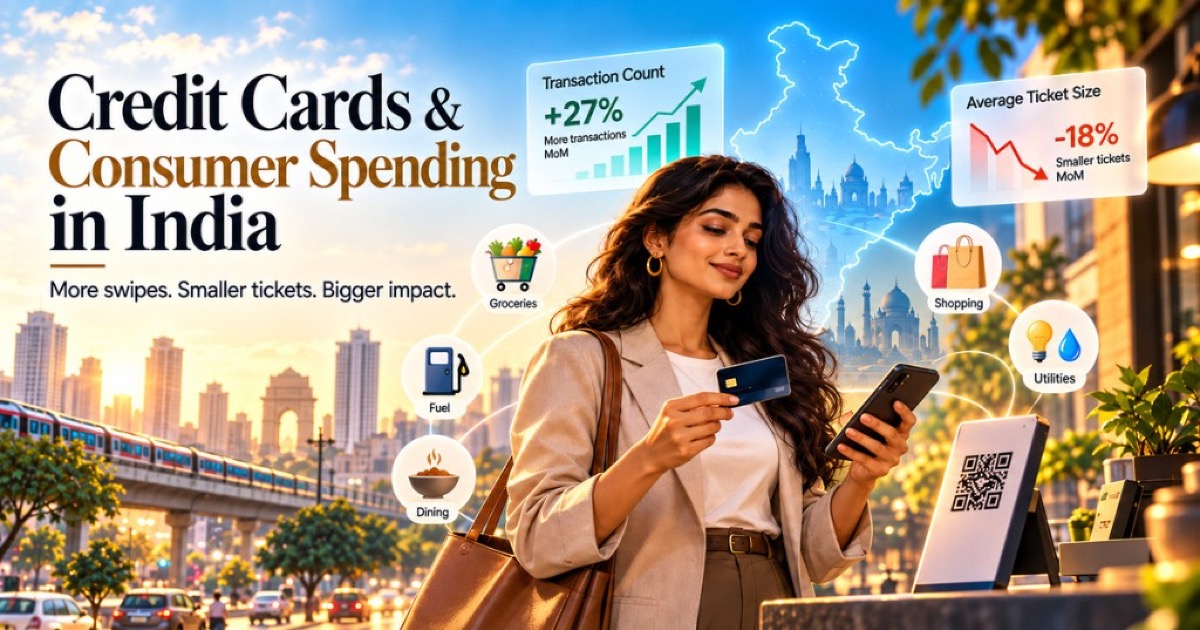
Indians are using credit cards more frequently—and increasingly for smaller, everyday purchases.
As of August 2026, India had approximately 124.05 million credit cards outstanding, up 10.3% from a year earlier. More importantly, credit-card purchase transactions grew 28.1% year-on-year, while the total value of those transactions grew only 5.9%.
That gap tells us something important about how Indian consumers are changing the way they spend.
Credit cards are gradually moving beyond flights, electronics and expensive purchases.
They are becoming part of everyday consumption.
Credit Card Usage in India: Key Statistics for 2026
Here is a snapshot of India’s credit-card market as of August 2026:
- Credit cards: Cards outstanding — +10.3% YoY
- Monthly volume: Purchase transactions — +28.1% YoY
- Monthly spend: Purchase value — +5.9% YoY
- Per purchase: Average ticket — −17.4% YoY
- August 2025: Average ticket — Larger typical purchase
- August 2026: Average ticket — Smaller everyday tickets
What does this mean?
Indians are making more credit-card transactions, but the average purchase is getting smaller.
This suggests that credit cards are increasingly being used for things such as:
- groceries
- fuel
- utility bills
- dining
- subscriptions
- apparel
- everyday online purchases
rather than being restricted primarily to large-ticket expenditure.
Why Are Credit Card Transactions Growing Faster Than Credit Card Spending?
Consider the difference:
- YoY: Transaction volume — More purchases
- YoY: Transaction value — Slower spend growth
- YoY: Avg ticket size — Smaller baskets
- YoY: Cards outstanding — Base still expanding
If consumers were simply buying more expensive products, transaction value should have risen at least as quickly as transaction count.
Instead, transaction frequency is increasing much faster.
That suggests credit cards are moving deeper into routine spending behaviour.
A customer who earlier used a card only for a ₹40,000 smartphone may now also use it for:
- ₹600 at a restaurant
- ₹1,200 at a supermarket
- ₹2,000 of fuel
- ₹499 for an online subscription
- ₹900 at a clothing store
Individually, these transactions may appear insignificant.
Together, they can materially change monthly household spending.
India Has 12.4 Crore Credit Cards—but Not 12.4 Crore Cardholders
One of the most misunderstood credit-card statistics in India is the number of cards outstanding.
India had approximately 124 million cards outstanding in August 2026.
But that does not mean 124 million Indians use credit cards.
TransUnion CIBIL estimates cited in the underlying research put the number of individual credit-card consumers at around 52 million as of March 2026.
This means multiple-card ownership is significant.
- Cards outstanding: Market scale — August 2026 — plastic / digital card accounts
- Unique consumers: Market scale — March 2026 — TransUnion CIBIL estimate
A person may have:
- one cashback card
- one travel card
- one premium rewards card
- one bank relationship card
Credit cards outstanding are not the same as unique credit-card users.
This distinction matters when analysing credit-card penetration in India.
UPI Still Dominates India’s Payments Market
Credit cards may be growing rapidly, but UPI remains in a completely different league when measured by transaction count.
In August 2026:
- txns: UPI — ₹29.82 lakh crore
- txns: Credit cards — ₹2.02 lakh crore
- txns: Debit cards — ₹0.37 lakh crore
- Of volume: UPI share — Dominant rail
- Of volume: Credit cards — Growing, still niche by count
So the future is unlikely to be UPI vs Credit Cards.
It is increasingly:
UPI for payments + credit cards for financing
And those two systems are beginning to merge.
RuPay Credit Cards on UPI Could Be the Biggest Shift Yet
India had approximately 813 million UPI QR codes compared with around 10.21 million POS terminals in August 2026.
That difference is enormous.
Historically, card acceptance depended heavily on merchants having POS terminals or online card-payment infrastructure.
But RuPay credit cards linked with UPI create a different model.
- Credit Card — Eligible RuPay credit line
- UPI App — Card linked inside a supported UPI app
- QR Code — Merchant’s UPI QR — no POS required
- Merchant — Purchase settles on the card statement
- UPI QR codes: Merchant acceptance — Massive QR network
- POS terminals: Merchant acceptance — Far smaller footprint
This potentially gives credit-card-funded spending access to India’s enormous UPI merchant network.
SBI Card has reported growing credit-card-on-UPI usage across categories such as:
- groceries
- utilities
- fuel
- restaurants
- apparel
- department stores
This is strategically important because it brings credit into places where traditional card acceptance may have been limited.
The ₹200 Credit-Card Purchase Could Matter More Than We Think
A ₹50,000 purchase feels expensive.
Consumers think about it. They compare prices. They may discuss it with family.
A ₹200 purchase usually receives almost no attention.
But:
- Total: 25 × ₹200 — Easy to miss
- Total: 50 × ₹200 — A real monthly line
- Total: 100 × ₹200 — Statement-level impact
The financial risk with increasingly frictionless credit may therefore not always come from one large purchase.
It may come from dozens of small purchases that individually feel harmless.
As credit-card payments increasingly resemble ordinary UPI payments, users may need to become more conscious of the source of money behind every transaction.
Because there is an important difference between:
- Bank debit: ₹500 payment — Leaves your account now
- Card credit: ₹500 payment — Added to next month’s statement
The checkout experience may look similar.
The financial impact is not.
How Credit Cards Can Influence Consumer Spending Behaviour
Credit cards affect spending through two different mechanisms.
- 1. Payment convenience: Cards reduce payment friction. There is no need to immediately part with physical cash or see money disappear from a bank account.
- 2. Access to credit: Cards also allow consumers to spend future income today. That distinction is fundamental.
A person who always pays the full credit-card bill is mainly using a card as a payment tool.
Someone carrying balances from one month to another is using it as a borrowing tool.
The Psychology Behind Credit Card Spending
Behavioural economics has studied what is sometimes called the pain of paying.
When someone pays ₹1,000 in cash, the cost is highly visible. You physically hand over money.
When someone pays digitally, the financial sacrifice can feel less immediate.
With a credit card, there is another layer: payment and consumption happen at different times.
The purchase happens today. The money may leave your bank account weeks later.
International behavioural research has found that payment methods can influence willingness to spend, while studies of credit-limit increases have shown that additional available credit can translate into higher borrowing—especially among liquidity-constrained consumers.
This does not mean every Indian automatically spends more simply because they own a card.
But it does explain why financial behaviour can change when spending becomes less immediately visible.
Are Credit Card Rewards Actually Saving You Money?
Cashback and rewards can genuinely create value.
Suppose you were already planning to spend ₹5,000. Your credit card gives you ₹250 cashback. You effectively reduced the purchase cost. That is a real benefit.
Now consider another situation. You were planning to spend ₹3,000. But the card says: spend ₹5,000 and receive ₹500 cashback. You spend an additional ₹2,000 to earn the reward.
Did you save ₹500? Not really. You spent ₹2,000 more than originally planned.
This is the difference between:
- Optimisation: Reward effect — Cashback on money you were already going to spend
- Induced consumption: Reward effect — Buying more only to unlock the offer
Credit-card programmes frequently use:
- cashback
- reward points
- milestone rewards
- annual-fee waivers
- lounge access
- accelerated points
- merchant discounts
These benefits are valuable when attached to planned expenditure.
They become expensive when they create expenditure that would otherwise never have occurred.
True Card Benefit = Rewards + Convenience + Protection + Interest-Free Credit − Fees − Interest − Unnecessary Spending
Credit Card Debt in India Is Also Rising
Another important trend is credit-card outstanding balances.
According to figures cited in the underlying research, Indian credit-card balances grew from approximately ₹0.4 lakh crore in 2016 to approximately ₹3.1 lakh crore in 2026.
That is roughly an 8.3x increase.
Over approximately the same period, individual credit-card consumers increased by around 3.6x.
- 2016 → 2026: Outstanding balances — ₹0.4L Cr → ₹3.1L Cr
- Similar period: Card consumers — Slower than balances
This does not automatically mean Indian households are facing a credit-card crisis.
Inflation, rising incomes, increasing credit limits and greater card usage all contribute.
But one conclusion is clear:
Credit exposure has grown considerably faster than the number of cardholders.
Credit cards are therefore increasingly functioning as a source of consumer liquidity—not merely as a digital replacement for cash.
Younger Indians Are Increasingly Entering the Credit Card Market
India’s future credit-card customer also looks different.
Among consumers receiving new credit cards:
- Of new cards: Age 30 or younger — Younger first-time borrowers
- Of new cards: Semi-urban / rural — Beyond metro-only growth
These figures apply to new entrants, not all Indian cardholders.
But the direction is clear.
Credit cards are gradually expanding beyond the traditional profile of high-income + salaried + metro consumer towards a broader population.
Smartphones, digital KYC, credit bureaus, app-based underwriting and UPI-linked cards can accelerate this shift further.
Full-Payment Users and Revolvers Have Completely Different Outcomes
Imagine two customers.
Both spend ₹40,000 per month.
- Full payer: ₹40,000 monthly spend — Pays the full statement — cashback, no revolving interest
- Revolver: ₹40,000 monthly spend — Pays minimum / partial — carries ₹35,000 forward
Both customers may technically be “credit-card users.”
Financially, however, they are doing completely different things.
Customer A is using a credit card mainly as a payment mechanism.
Customer B is using it as unsecured debt.
This distinction is one of the most important things consumers should understand about credit cards.
The Minimum Amount Due Is Not a Normal Repayment Strategy
Credit-card statements prominently display a Minimum Amount Due.
That number can create a dangerous psychological impression. It may appear that paying the minimum amount is an acceptable monthly repayment plan.
But the minimum payment mainly helps prevent immediate delinquency. The remaining amount continues as outstanding credit and can attract substantial finance charges.
Where possible, users should configure:
- Preferred: Autopay setting — Treat the card like delayed settlement
- Risky default: Autopay setting — Keeps balances revolving
A credit card works best financially when it is used like a debit card with delayed settlement.
Are Credit Cards Good or Bad for Personal Finance?
Neither.
Credit cards are financial tools. Their impact depends largely on how they are used.
- Interest-free payment periods: Useful when you repay in full
- Cashback & rewards: Valuable on planned spending
- Travel benefits & protection: Can add real utility
- Expense records & credit history: Helpful visibility and bureau history when used well
- Habitual revolving debt: Interest turns convenience into cost
- Impulse purchases & reward-driven spend: Offers can create purchases you never planned
- High utilisation & overlapping EMIs: Stresses cash flow and credit metrics
- Minimum-payment dependency: Looks affordable; balances linger
The card itself is neither financially responsible nor irresponsible.
The behaviour around it determines the outcome.
Three Questions to Ask Before Every Credit Card Purchase
Before tapping, swiping or scanning using credit, ask yourself:
- Would I buy this using money already in my bank account? — If yes, the card is probably a payment tool. If no, available credit may be influencing the purchase.
- Can I pay my entire credit-card bill next month? — If the answer is consistently no, you are no longer merely using a card — you are borrowing.
- Would I still buy this without the cashback or reward? — If not, the reward may actually be increasing your spending rather than saving money.
What Does the Future of Credit Cards in India Look Like?
India’s credit ecosystem is evolving towards convergence between:
- UPI
- credit cards
- card EMIs
- BNPL
- small personal loans
- digital underwriting
- credit-line-on-UPI
From a technology perspective, this can dramatically improve access to credit.
From a personal-finance perspective, it creates a new challenge:
Borrowing may become almost invisible.
Historically, taking a loan required a deliberate process — an application, documents, approval, disbursal.
A credit-card-linked QR payment can potentially convert borrowing into something that feels almost identical to making an ordinary ₹300 UPI payment.
That is a major behavioural shift.
What RBI Is Doing About Unsecured Consumer Credit
RBI has already responded to rapid unsecured-credit expansion.
In November 2023, it increased the risk weight on certain bank credit-card receivables by 25 percentage points to 150%.
This effectively requires banks to maintain more regulatory capital against credit-card exposure.
The intention is not to eliminate consumer credit. It is to encourage:
- responsible underwriting
- adequate capital buffers
- sensible credit-limit management
- better portfolio monitoring
- sustainable growth
As India’s credit ecosystem expands, the challenge will be balancing greater credit access with household financial resilience.
Inly Perspective: Know Where Your Money Is Actually Going
Credit cards make spending easy.
The harder part is understanding what all those transactions collectively mean for your finances.
A ₹399 subscription. A ₹1,200 dinner. A ₹2,000 fuel payment. A ₹6,000 EMI. A ₹950 shopping order.
Viewed individually, these may not appear significant.
But personal finance is rarely affected by one transaction.
It is shaped by patterns.
This is where Inly can help.
Inly helps you understand your financial activity using the transactional information already present in your SMS messages.
Instead of manually tracking every transaction, you can get a clearer picture of:
- spending patterns
- EMIs
- loans
- credit-card payments
- subscriptions
- recurring expenses
- upcoming payments
- financial behaviour
- overall money patterns
You can also chat with your financial data and ask questions about your own finances.
For example:
- “How much did I spend on shopping this month?”
- “What are my upcoming EMIs?”
- “How much am I spending on subscriptions?”
- “Has my monthly spending increased?”
- “Where is most of my money going?”
Understanding these patterns becomes especially important as payment and credit increasingly merge.
The goal is not to stop spending. It is to understand before you spend.
Bharat’s Money Lens. Understand Before You Spend.
Frequently Asked Questions
Quick answers to the questions readers ask most about credit cards and consumer spending in India.
How many credit cards are there in India in 2026?
India had approximately 124.05 million credit cards outstanding as of August 2026, according to RBI data cited in the research.
How many Indians actually have credit cards?
The number of cards is much higher than the number of individual users. TransUnion CIBIL estimates cited in the research suggest approximately 52 million individual credit-card consumers as of March 2026.
Is credit card usage increasing in India?
Yes. Credit-card purchase transaction volume grew approximately 28.1% year-on-year in August 2026, while cards outstanding increased around 10.3%.
Are Indians using credit cards for smaller purchases?
The data strongly suggest this trend. Average credit-card purchase value declined from approximately ₹3,873 to ₹3,201 year-on-year while transaction volumes increased sharply.
Is UPI bigger than credit cards in India?
Yes, by a very large margin in transaction count. UPI processed approximately 24.51 billion transactions in August 2026, compared with roughly 632 million credit-card purchase transactions.
Can credit cards be used through UPI?
Eligible RuPay credit cards can be linked to supported UPI applications and used for eligible merchant payments, allowing card credit to be accessed through QR-based payment infrastructure.
Do credit cards make people spend more?
International behavioural research suggests that reduced payment friction, delayed payment and increased available credit can influence spending behaviour. However, the available Indian aggregate statistics alone cannot establish that credit cards directly cause higher spending.
Is paying only the minimum amount due on a credit card safe?
It may prevent immediate delinquency under the card’s terms, but the unpaid balance generally remains outstanding and may attract finance charges. Paying the full statement amount is financially preferable whenever possible.
Is having multiple credit cards bad?
Not necessarily. Multiple cards can provide higher total limits and different rewards, but they can also make it more difficult to track total outstanding balance, due dates, annual fees, EMIs and overall credit utilisation. The key is maintaining visibility and repayment discipline.
Final Takeaway
India’s credit-card market is entering an interesting phase.
The number of cards continues to rise. But transaction frequency is growing even faster. Average ticket sizes are falling. Younger consumers are entering the market. Credit cards are expanding outside metros.
And perhaps most importantly: credit is increasingly merging with India’s UPI and QR-payment infrastructure.
That can make borrowing extraordinarily convenient. But convenience can also make borrowing less visible.
The smartest credit-card users therefore don’t just track their credit limit.
They track their actual spending behaviour.
Because eventually, every ₹200 purchase becomes part of a monthly number. And that number is what determines whether your finances are moving forward—or quietly becoming harder to control.
Understand your money before you spend it.
Download Inly and get a clearer view of your spending, EMIs, subscriptions, loans and financial patterns—all in one place.
Inly — Bharat’s Money Lens. Understand Before You Spend.
Sources: RBI retail payment and credit-card statistics (August 2026 figures as cited); TransUnion CIBIL estimates on individual credit-card consumers (March 2026 as cited); SBI Card commentary on credit-card-on-UPI category usage; RBI risk-weight measures on certain bank credit-card receivables (November 2023). International behavioural findings on payment methods and credit limits are cited as research context, not India-specific causal proof. Statistics retain their original observation periods. Household examples are illustrative and do not constitute lending, investment or tax advice.