· 14 min read
Credit Card Debt Traps in India: Easy to Swipe, Hard to Escape
India's credit-card market looks shiny from the outside. More cards. More rewards. More airport lounges. More QR-code payments with linked credit. More "no-cost EMI" offers at checkout. More digital convenience.
And yes, the market really has grown hard. Outstanding credit cards in India rose from 6.20 crore in March 2021 to 11.86 crore in March 2026. Annual spending on cards jumped from about ₹6.30 lakh crore in FY2021 to ₹23.62 lakh crore in FY2026. Between 2019 and 2024 alone, credit-card transactions more than doubled in volume and nearly tripled in value.
That sounds like a success story. And in one sense, it is. India's payments architecture has become deeper, more formal and more digital. But there is another side to the same story: the rise of the credit-card debt trap.
The trap is not just "people spending too much". That framing is lazy. The real trap is structural. It comes from how credit cards are designed, priced and psychologically experienced.
The Minimum Amount Due Trap
Start with the most dangerous feature of all: the minimum amount due. It looks harmless. It feels responsible. It lets a user think, "I've paid my bill."
But RBI had to force issuers to print a warning right on statements saying that paying only the minimum due can stretch repayment over "months / years" and lead to compounded interest. RBI also had to require that credit-card payment terms should not create negative amortisation.
Regulators do not write warnings like that unless a lot of consumers are getting burned by exactly that behaviour.
Once the full amount is not paid, the interest-free credit period is suspended — so new purchases can also start attracting finance charges. The bill looks "handled" even while the principal barely falls.
The Real Price of Revolving Debt
RBI requires APR disclosure. In actual issuer pricing, it is savage.
Axis Bank's published terms show finance charges of 3.75% per month, which annualises to 55.55% on one sample card. Its own explainer places credit-card APRs in the 24% to 49% range.
That means a carried balance is not small, friendly household debt. It is very expensive unsecured debt. Once a consumer revolves at those rates, even small balances can become sticky very quickly.
How Psychology Makes It Worse
People do not usually think in APR. They think in monthly cash flow. A ₹20,000 purchase suddenly feels acceptable when it is reframed as "just ₹1,900 per month".
This is classic mental accounting. The consumer stops processing the purchase as debt and starts processing it as an instalment. RBI's statement warnings are basically an attempt to counter that with better framing, but the commercial ecosystem pushes the other way.
Present bias also plays a role: consumers systematically overweight immediate utility and underweight future repayment pain. That is exactly why the minimum due is so effective as a framing device. In India's household setting — where liquidity is frequently earmarked for family obligations — maintaining visible cash can feel safer than extinguishing high-cost unsecured debt. Rational in the short term. Expensive in the medium term.
EMI Conversion Is Not Always Escape
EMI conversion is not always bad. In some cases it is a more controlled alternative to revolving. But it can still become a trap when it lowers the psychological salience of total debt.
CRIF High Mark notes a clear shift in customer preference towards EMI-based products. SBI Card's FY2024 investor presentation showed EMI and value-added services accounted for 36% of its revenue mix.
That tells you instalments are not a side feature. They are part of the machine. Treat EMI as a restructuring tool — not a shopping tool.
When Credit Feels Like Just Another UPI Tap
India's digital habits are changing the game. RuPay credit on UPI is blurring the boundary between "payment" and "borrowing".
An industry note citing Ministry of Finance data reported that RuPay credit on UPI clocked 750 million transactions worth ₹63,825.8 crore by October FY25 — up sharply from 362.8 million transactions worth ₹33,439.2 crore in FY24.
In plain English: credit is moving into the same scan-and-pay behaviour that Indians already perform reflexively every day. That does not automatically mean disaster. But it does mean the pain of payment is shrinking while the cost of credit remains high. That combination is dangerous.
What the Market Data Already Shows
Credit-card balances rose from ₹1.8 lakh crore in March 2022 to ₹3.0 lakh crore in March 2024, and then hovered around ₹3.4 lakh crore by December 2025 and March 2026.
Delinquencies worsened meaningfully before improving:
- Balances overdue by 91 to 360 days jumped 44.34% year-on-year to ₹33,886.5 crore by March 2025
- Gross NPAs in banks' credit-card books rose to about 2.3% by December 2024, up from 2.06% a year earlier
- Later bureau snapshots showed early-stage delinquency improving by March 2026 — suggesting banks have started tightening underwriting
- New cards issued fell from 294.4 lakh in FY24 to 226.7 lakh in FY25 and 192.3 lakh in FY26
Who Is Most Exposed?
Public data are imperfect, but they still tell a story:
- The 18–25 age group has the highest early delinquency among top issuers (2.62%), followed by 26–35 (2.22%)
- Lower-limit cards are far riskier — LAR 30+ is 3.65% for limits under ₹25,000, versus 0.39% for ₹3 lakh+
- Sub-₹25,000 cards outside the biggest cities are especially fragile
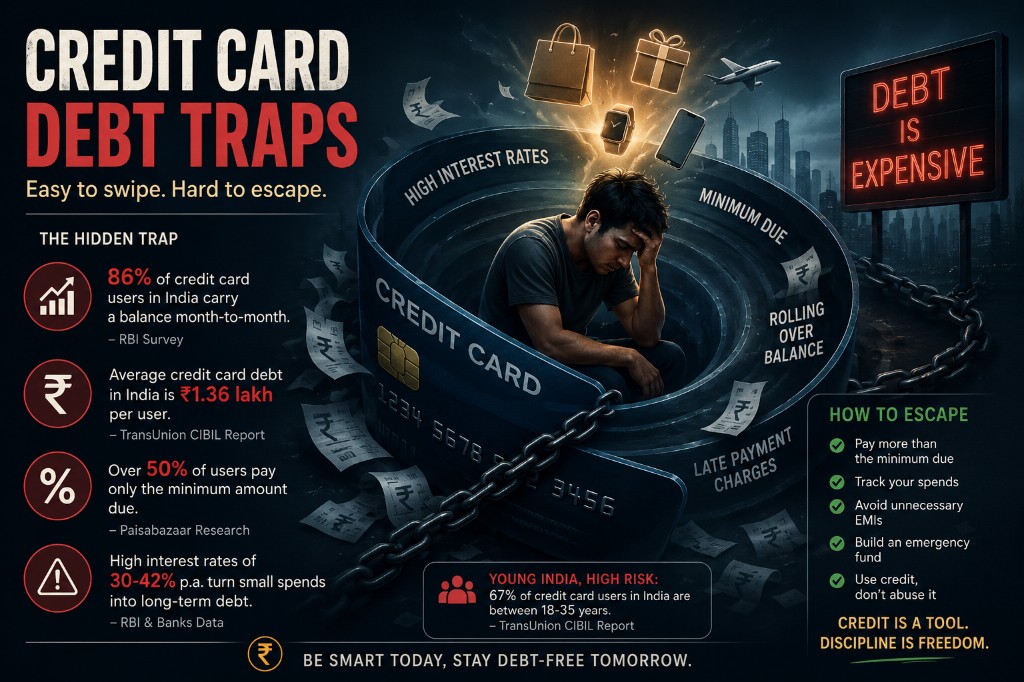
- 67% of credit-card users in India are between 18–35 years
- 41% of first-time borrowers are Gen Z; 75% of self-monitoring consumers and 78% of new-to-credit consumers are from non-metros
- Overall financial literacy in India is estimated at just 27%
So the country is expanding credit access faster than it is expanding understanding. Digitally fluent does not mean cost-of-credit ready.
Other Traps Worth Watching
- Cash advances: Feel like liquidity, but carry an explicit fee on top of finance charges — often 2.5% with a minimum of ₹500, plus interest from day one
- Limit inflation: Extra credit limit feels like extra income. RBI now bans unilateral limit enhancements, but the behavioural risk remains
- BNPL and POS overlap: Checkout credit from multiple rails at the same moment makes it easy to stack debt without noticing
- Rewards-led spending: Festival and sale cycles push present bias harder when points and cashback make overspending feel "smart"
What RBI Has Already Done
RBI has not been asleep. Its 2022 card directions and 2024 clarifications now require:
- APR disclosure with examples
- Prominent warnings on minimum-due implications
- No negative amortisation
- No unsolicited cards or unilateral limit enhancements
- Explicit consent for over-limit use
- Late-payment charges only on the outstanding amount after the due date — not the full bill
In 2023, RBI also raised the risk weight on credit-card receivables — a clear sign that it saw unsecured retail risk heating up. That prudential tightening fed into slower issuance and a pivot from expansion to calibration.
How to Escape the Trap
The most effective defences are boring, mechanical and brutally effective:
- Set autopay for the full amount due wherever possible
- If cash flow is uneven, set autopay far above the minimum — and treat any carried balance as an emergency, not routine behaviour
- Ask the issuer to align the billing cycle with your salary date
- Disable cash withdrawal and over-limit features unless you genuinely need them
- Treat EMI conversion as a restructuring tool, not a shopping tool
- Keep utilisation low — credit bureaus treat high utilisation and late payments as negative signals
- Track your spends so you see category creep before the bill arrives
- Build an emergency fund so you don't reach for the card when cash gets tight
- Use credit. Don't abuse it.
What Should Change Next
The biggest missing piece is not more disclosure — it is better disclosure architecture.
Every card statement in India should carry a dynamic payoff calculator: "If you pay only the minimum due, you will take X months and pay Y in interest." RBI already requires warnings and illustrations; the logical next step is a standardised payoff estimate on every statement and in every app view.
Policymakers should also push for cleaner public data on write-offs, EMI balances and first-time-borrower delinquency — and more friction for first-time credit-on-UPI linking, not for payments themselves.
The Bottom Line
India does not primarily have a credit-card access problem. It has an underwriting-quality, disclosure-design and financial-cognition problem.
Right now, debt is being sold in a form that feels frictionless, modern and even aspirational — while the repayment mathematics remain old-school brutal.
Credit is a tool. Discipline is freedom.
Be smart today, stay debt-free tomorrow.