· 7 min read
Why Indians Save More Than Americans: Culture, Economics, and the Future of Financial Awareness
For decades, India has been known as a nation of savers.
While headlines often celebrate rising consumption, growing credit card usage, and increasing access to loans, one financial habit continues to distinguish Indian households from many developed economies: the ability and willingness to save.
In fact, India's savings rate remains significantly higher than that of the United States and several other developed economies. This difference is not accidental — it is rooted in culture, family structures, economic realities, and financial behavior.
But while Indians are saving more, a new challenge has emerged:
Many people save diligently, yet still struggle to understand where their money actually goes.
The Numbers Tell an Interesting Story
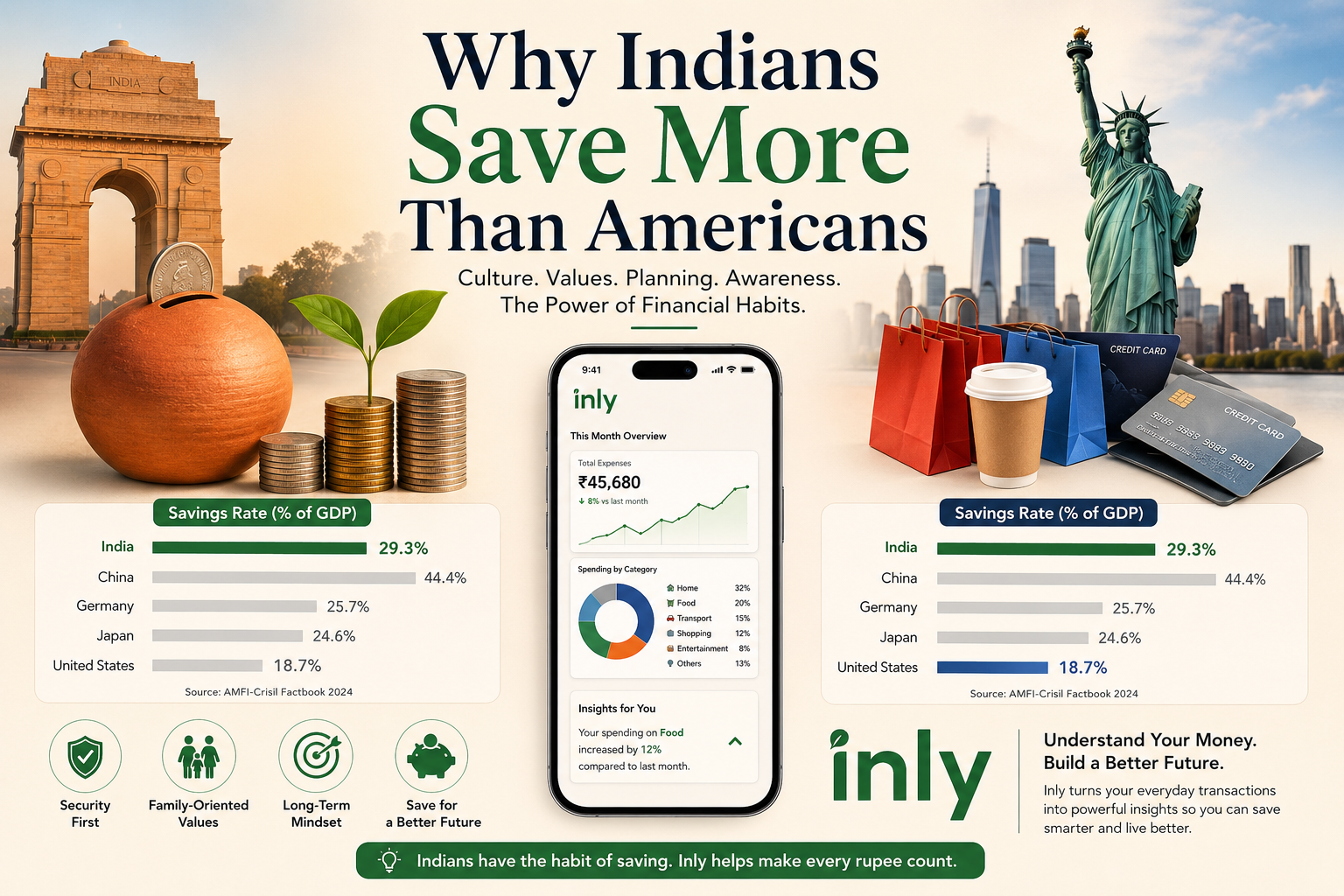
India's gross domestic savings rate stood at approximately 29–31% of GDP in recent years, compared to around 19% in the United States. India also remains above the global average savings rate of roughly 27%.
- Singapore — 58.5%
- China — 44.4%
- Indonesia — 38.1%
- India — 29.3%
- Germany — 25.7%
- Japan — 24.6%
- United States — 18.7%
- United Kingdom — 16.6%
Source: AMFI-Crisil Factbook 2024 and related economic reports.
India's savings culture has helped create one of the world's largest pools of household wealth. Household savings continue to account for over 70% of total domestic savings in the country.
Why Do Indians Save More?
1. Financial Security Is Deeply Cultural
For many Indian families, saving is not merely a financial activity. It is a value.
Generations have been taught:
- Save before spending
- Avoid unnecessary debt
- Build an emergency fund
- Plan for children's education
- Prepare for retirement independently
In contrast, Western economies — particularly the United States — have historically encouraged consumption-led growth, where spending drives economic expansion. As a result, Americans are generally more comfortable financing purchases through credit, while Indians tend to prefer accumulating savings before making large purchases.
2. Social Safety Nets Are Limited
Americans have access to extensive retirement systems, unemployment benefits, social security programs, and various welfare mechanisms.
India's social safety infrastructure is improving, but most households still cannot rely entirely on government support. This creates a strong incentive to save for:
- Medical emergencies
- Job loss
- Children's education
- Weddings
- Retirement
- Family responsibilities
For many Indians, savings represent protection against uncertainty.
3. Joint Family Thinking Creates Long-Term Planning
Indian households often think collectively rather than individually. Financial decisions frequently involve parents, children, spouses, and extended family members.
This encourages longer planning horizons. Money is often viewed not just as personal wealth but as a resource that supports multiple generations.
4. Indians Historically Preferred Assets Over Consumption
Indian households have traditionally accumulated wealth through bank deposits, gold, real estate, provident funds, and insurance products.
Today, that behavior is evolving. Recent data shows a growing shift toward mutual funds, equity investments, SIPs, and market-linked products. The share of equity and mutual funds in annual household financial savings has risen from around 2% in FY12 to over 15% in FY25.
This indicates that Indians are not only saving — they are becoming increasingly sophisticated investors.
But There Is A Problem Nobody Talks About
Despite being strong savers, many Indians struggle with one fundamental question:
"Where exactly did my money go this month?"
Most people can instantly tell you their bank balance, their salary, and their EMI amount. But very few can accurately answer:
- How much they spent on food
- How much went to subscriptions
- How much was spent through UPI
- How much was spent on impulse purchases
- Whether spending increased or decreased compared to last month
Ironically, people often focus heavily on increasing income while paying very little attention to understanding expenses.
The Rise Of Invisible Spending
India's digital payments revolution has transformed the way money moves. Thanks to UPI, credit cards, net banking, wallets, and auto-debits, spending today happens faster than ever.
The convenience is incredible. The visibility is not.
A ₹99 subscription here. A ₹299 food order there. A ₹499 recharge. A few UPI transfers. Several online purchases.
Individually, these transactions seem insignificant. Collectively, they can materially affect savings.
The easier spending becomes, the more important tracking becomes.
Saving More Starts With Understanding More
The future of personal finance is not just about earning more or investing better. It starts with awareness.
You cannot optimize what you do not measure.
You cannot improve what you do not understand.
And you cannot build long-term wealth if you do not know where money is leaking every month.
How Inly Helps
Inly is built around a simple idea: financial awareness should not require spreadsheets, manual entries, or complicated budgeting apps.
By intelligently analyzing transaction messages from banks, UPI apps, cards, and merchants, Inly helps users:
- Automatically track expenses
- Categorize spending patterns
- Identify recurring expenses
- Monitor category-wise spending
- Understand monthly trends
- Discover hidden spending habits
- Make more informed financial decisions
Instead of asking users to manually record every transaction, Inly converts everyday financial activity into meaningful insights.
Final Thoughts
Indians have built one of the strongest savings cultures in the world. That culture has helped millions of families create financial stability, navigate uncertainty, and build wealth across generations.
But in a world dominated by instant digital payments, saving alone is no longer enough.
The next step is understanding.
Because the people who understand their money are ultimately the people who manage it best.
India made saving a habit.
Now it's time to make financial awareness a habit too.
That's where Inly comes in.