· 8 min read
How to Track Every Rupee You Spend: The Complete Guide to Better Money Management
Most people know how much they earn.
Far fewer know how much they spend.
And even fewer can answer a simple question: "Where exactly did my money go last month?"
In today's India, spending has become almost invisible. UPI, cards, subscriptions, auto-debits, and one-click purchases have made payments incredibly convenient. But they have also made it easier than ever to lose track of money.
The reality is simple:
You cannot improve what you do not measure.
Tracking every rupee you spend is one of the most powerful habits you can build — not because it restricts spending, but because it creates awareness.
Why Tracking Matters More Than Ever
India is experiencing one of the largest digital payment revolutions in the world.
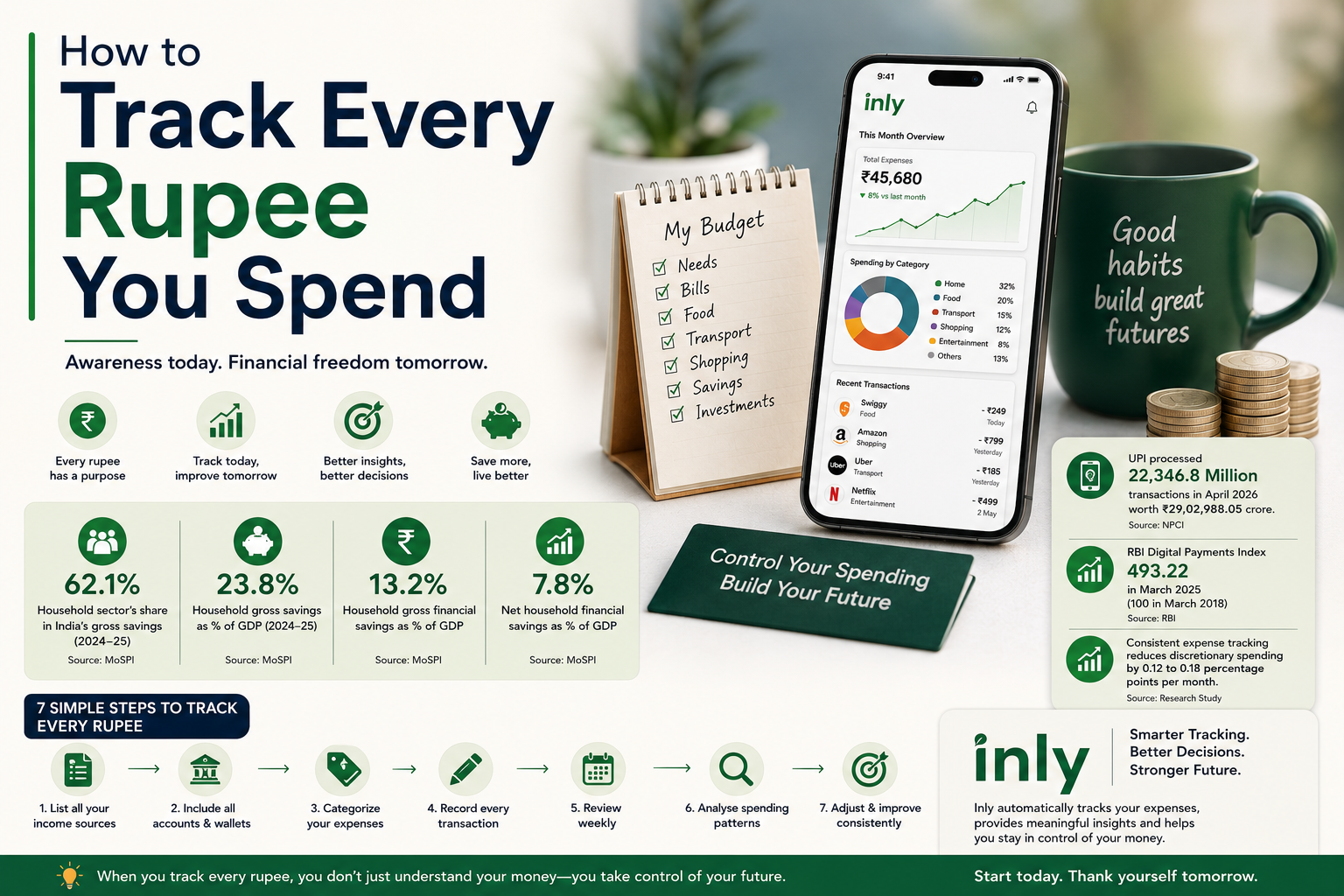
In April 2026 alone, UPI processed over 22 billion transactions worth more than ₹29 lakh crore. Almost every payment now leaves a digital trail.
At the same time, household budgets are under pressure from rising education costs, healthcare expenses, transportation costs, lifestyle inflation, subscription services, and online shopping.
The challenge isn't necessarily that people spend too much. The challenge is that most people don't know where the spending is happening.
A ₹99 subscription. A ₹199 coffee order. A ₹499 impulse purchase. A ₹799 online sale. Individually, they seem harmless. Together, they can quietly consume thousands of rupees every month.
The Hidden Cost of Untracked Spending
Modern household budgets are no longer simple. Money flows through multiple channels:
- UPI apps
- Credit cards
- Debit cards
- Bank transfers
- Cash
- Wallets
- Auto-debits
Without a system to monitor these transactions, financial leaks become almost inevitable.
The result? Many people feel financially stretched despite earning well.
Research Says Tracking Works
Studies consistently show that people who regularly track their expenses become more conscious of discretionary spending. The benefits include:
- Better budgeting
- Increased savings
- Reduced impulse purchases
- Improved financial awareness
- Stronger long-term financial discipline
Interestingly, research has also shown that the simple act of recording expenses can be almost as effective as formal financial education in improving money management behavior.
Tracking changes behavior.
The Best Ways to Track Expenses
1. Traditional Expense Diary
The oldest method still works. Simply writing down every expense creates awareness and accountability.
Pros: Simple, low cost, effective.
Cons: Time-consuming, easy to abandon.
2. Spreadsheet Tracking
Many financially disciplined people use Google Sheets or Excel. Spreadsheets offer complete customization, detailed reporting, budget planning, and historical analysis.
Pros: Extremely flexible, powerful insights.
Cons: Requires manual effort, difficult to maintain consistently.
3. Budgeting Frameworks
Two popular methods that work well when combined with tracking:
The 50-30-20 Rule
- 50% Needs
- 30% Wants
- 20% Savings
Zero-Based Budgeting
Every rupee receives a specific job before the month begins. Both methods can improve financial control significantly.
A Simple 7-Step Expense Tracking System
Step 1: Create One Source of Truth
Include every account and payment method:
- Bank accounts
- UPI apps
- Credit cards
- Cash
- Wallets
Step 2: Create Spending Categories
Keep categories simple and practical:
- Housing
- Groceries
- Food & Dining
- Transport
- Shopping
- Utilities
- Healthcare
- Education
- Entertainment
- Savings & Investments
Step 3: Record Fixed Expenses First
These are the foundation of your budget:
- Rent
- EMI payments
- Insurance
- SIPs
- Utility bills
Step 4: Track Daily Spending
Every transaction should be categorized. The closer the tracking happens to the transaction, the more accurate the system becomes.
Step 5: Don't Ignore Cash
Cash spending is where visibility often disappears. Track withdrawals and allocate them to categories.
Step 6: Review Weekly
Spend 10 minutes every Sunday reviewing category totals, budget variances, and unusual spending. Small corrections during the month prevent large surprises later.
Step 7: Review Month-End Performance
Focus on three numbers: total spending, total savings, and largest overspending category. Then adjust next month's budget accordingly.
Small Leaks Become Big Problems
Many people underestimate how quickly small daily expenses accumulate into significant annual costs:
- ₹50/day → ₹18,250 per year
- ₹100/day → ₹36,500 per year
- ₹150/day → ₹54,750 per year
- ₹300/day → ₹1,09,500 per year
That's the power of awareness. A small daily habit can have a surprisingly large annual impact.
How Inly Helps
Expense tracking is easy in theory. Consistency is where most people struggle.
The problem isn't discipline. The problem is friction.
Most people don't want to update spreadsheets daily, maintain notebooks, or manually categorize transactions.
That's where Inly helps. By analyzing transaction messages from banks, UPI apps, cards, and merchants, Inly helps users:
- Automatically track expenses
- Understand spending patterns
- Monitor category-wise spending
- Identify recurring expenses
- Plan budgets more effectively
- Build stronger financial habits
Instead of spending time entering transactions, users can focus on understanding and improving their finances.
Final Thoughts
Tracking every rupee isn't about becoming obsessed with money.
It's about becoming aware of it.
India has embraced digital payments faster than almost any country in the world. The next step is building financial awareness alongside that convenience.
Because the people who understand where their money goes are usually the people who manage it best.
You don't need a perfect system. You simply need a system you can stick with.
And that's exactly the habit Inly is designed to help build.