· 14 min read
Why Every Family in India Needs a Financial Dashboard
Salary credited. Rent paid. SIP deducted. A few UPI payments later, everything still seems under control.
Then the school-fee reminder arrives. The insurance premium is due next week. There is a credit-card bill mentally assigned to “next month”. Suddenly, the money that looked available already has several jobs waiting for it.
A family can earn regularly, save sincerely and still struggle to answer a basic question:
How much money can we actually afford to spend?
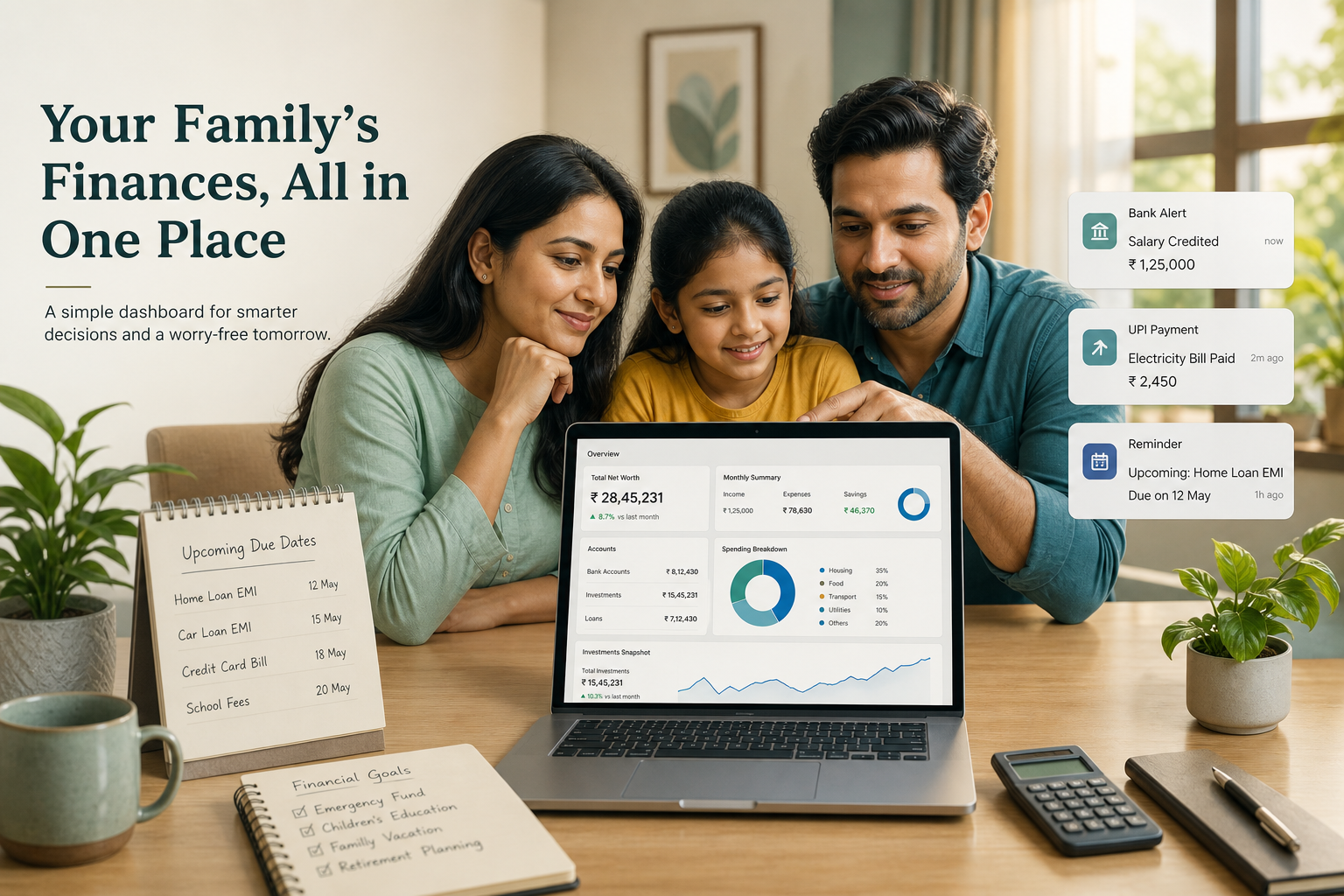
A family financial dashboard brings income, spending, debts, savings and upcoming commitments into one regularly updated view. It connects what has happened with what needs to happen next.
The most useful number is often the amount left after all commitments are accounted for.
India Has Made Paying Easier. Planning Needs a Connected View.
In FY2025–26, UPI processed approximately 24,162 crore transactions worth ₹314 lakh crore, according to the Ministry of Finance, citing NPCI data.
This reflects the extraordinary scale of India’s digital payment infrastructure. However, these figures include transfers as well as purchases. They do not prove that UPI causes overspending.
They do explain why digital transaction records have become useful raw material for household financial planning.
- Transactions: UPI volume — FY2025–26
- Transaction value: UPI value — Includes transfers & purchases
- Infrastructure: What it proves — Not proof of overspending
- Planning raw material: What it enables — If categories are clear
A grocery payment, a transfer to a spouse, a credit-card repayment and an investment contribution may all appear as debits. But each has a different financial meaning.
Without this context, families may count the same money twice or mistake a transfer for actual spending.
- Household consumption: Actual spending that reduces purchasing power
- Family transfers: Money moving between members — not new expense
- Debt repayments: Settling liabilities already created
- Investment contributions: Wealth allocation, not lifestyle spend
- Cash & refunds: Withdrawals, refunds and reimbursements need separate treatment
- Recurring vs one-time: Commitments that repeat versus occasional outflows
The ₹20,000 Surplus That Was Really ₹5,000
Consider an illustrative household with a combined monthly take-home income of ₹1,10,000.
These figures are only for demonstrating the calculation. They do not represent the average Indian family.
- ₹55,000: Essential living & dependent support — Core household costs
- ₹25,000: Scheduled loan EMIs — Fixed debt service
- ₹10,000: Planned investments — SIPs and similar contributions
- ₹7,500: School fees provision — ₹90,000 annually ÷ 12
- ₹4,000: Insurance provision — ₹48,000 annually ÷ 12
- ₹3,500: Repairs & occasions — ₹42,000 annually ÷ 12
- ₹5,000: Planned free cash — Truly unallocated after all provisions
- Apparent: Monthly surplus — After living costs, EMIs and investments — before annual bills
- Genuine: Monthly surplus — After school fees, insurance and occasions are reserved
- Vs ₹20k view: New ₹8,000 EMI — Seems manageable against the apparent surplus
- Vs ₹5k free cash: New ₹8,000 EMI — Creates a monthly shortfall once real free cash is used
The household has annual obligations of ₹1,80,000. Spread over twelve months, these require a monthly provision of ₹15,000.
The apparent surplus is ₹20,000. The genuinely unallocated amount is only ₹5,000.
Now imagine the family considering a new ₹8,000 EMI. Against the apparent ₹20,000 surplus, the loan may look manageable. Against the actual ₹5,000 free cash, it creates a monthly shortfall of ₹3,000.
That is the practical value of a dashboard: it makes the trade-off visible before the purchase.
School fees, insurance renewals, festival spending, repairs and family travel are predictable even when they do not occur every month. They should not be treated as unexpected expenses.
If a ₹60,000 bill is due in three months and no amount has been reserved, the household needs to set aside ₹20,000 per month. Dividing it by twelve would create false comfort.
Saving Money Is a Start. Knowing Its Purpose Comes Next.
NABARD’s All India Rural Financial Inclusion Survey found that 66% of surveyed rural households reported saving money in 2021–22, up from 50.6% in 2016–17.
This shows wider participation in saving. It does not establish whether every household had an adequate emergency reserve.
The same distinction matters inside a family.
- 2021–22: Rural households saving — Reported saving money
- 2016–17: Earlier participation — Same survey series
- Participation: What it shows — More households are saving
- Emergency reserve: What it does not prove — Saving ≠ enough runway
Money saved for school fees is already committed. A retirement balance may have access restrictions. A property contributes to net worth but may not help with an urgent payment.
The same ₹1 lakh should not quietly be counted as the emergency fund, holiday fund and next year’s school-fee reserve.
- Total wealth: Everything the family owns on paper
- Accessible cash: What can be used without delay or penalty
- Emergency reserves: Liquidity ring-fenced for shocks
- Earmarked for known bills: Already assigned to school fees, premiums, travel
- Long-term investments: Growth assets with access constraints
- Goal-specific savings: Named pots that should not be double-counted
- Emergency cash: Liquid reserve — Separate from annual bills
- Living + EMIs / mo: Essential outgo — Excluding investments
- Runway: Coverage — If annual bills are funded separately
- Real cushion: If bills unfunded — True runway shrinks
For the illustrative family above, a separate liquid emergency reserve of ₹1,80,000 would cover approximately 2.25 months of ₹80,000 essential living costs and EMIs.
This calculation assumes annual bills are funded separately. If they are not, the real emergency cushion is lower.
There is no universal emergency-fund number suitable for every family. The right target depends on income stability, dependants, medical needs, debt obligations and access to family support.
How long could your household continue if income stopped temporarily?
Put Every Repayment on the Same Calendar
A home loan may sit in one banking app, a vehicle loan in another and a credit-card balance in an email. Each payment may look reasonable on its own. Together, they determine the family’s financial flexibility.
A good credit score cannot answer whether this month’s school fees, medicines and groceries are affordable. Actual income, payment timing and household commitments can.
- Outstanding balance: What is still owed across products
- Interest rate & EMI: Price and monthly instalment for each obligation
- Due date & tenure: When payment hits and how long it continues
- Card amount due: Statement balances that often hide in email
- Secured or unsecured: What collateral, if any, stands behind the loan
- Prepayment options: Whether surplus cash can reduce future inflexibility
A dashboard should also allow families to test scenarios.
In the example above, a 10% income reduction would reduce monthly receipts by ₹11,000. If all allocations remained unchanged, the planned ₹5,000 surplus would become a ₹6,000 monthly shortfall.
Seeing that early gives the family time to revise investments, delay a purchase or reduce discretionary spending.
- ₹5,000: Planned free cash (base case) — After all allocations
- −₹11,000: Income lost at −10% — ₹1,10,000 → ₹99,000 take-home
- −₹6,000: Resulting monthly gap — If every allocation stays unchanged
Bring Medical Costs and Protection into the Picture
India’s National Health Accounts estimates show that out-of-pocket payments accounted for 43.4% of total health expenditure in FY2022–23.
This is a national health-financing measure. It is not the percentage of income that every household spends on healthcare.
For a family dashboard, the practical lesson is to make medical costs and protection easy to review.
- Of total health spend: Out-of-pocket share — FY2022–23 national estimate
- Household risk: What it means — Medical shocks can still hit cash
- Protection: Dashboard lesson — Make policies easy to check
- Employer policy: Job-linked cover — May change with employment
- Coverage by member: Who is insured, and under which policy
- Sum insured & renewal: Limits and the date cover must be renewed
- Employer-provided cover: Identify it clearly — a job change can remove it overnight
- Documents & claims: Where papers live and how to start a claim
- Exclusions & waiting periods: A premium payment alone does not prove adequate cover
- Known medical costs: Regular medicines, consultations and upcoming expenses
Make the Family’s Financial Memory Shareable
If the person who usually manages the family’s money became unavailable for a month, could another authorised family member find the accounts, pay the bills and locate the insurance documents?
The Ministry of Finance reported ₹60,518 crore in unclaimed deposits transferred by public-sector banks to the RBI’s Depositor Education and Awareness Fund as of 31 January 2026.
These funds remain claimable. The figure does not explain why individual deposits became unclaimed, but it highlights the importance of keeping financial records discoverable.
- PSB transfers to DEA Fund: Unclaimed deposits — Still claimable
- Records: Lesson for families — Keep assets findable
- Common bills & goals: Shared planning — Not every personal txn
- PINs / passwords: Never store — Keep credentials out
- Accounts & deposits: Bank accounts, FDs and nomination details
- Investments & insurance: Mutual funds, policies and maturity dates
- Loans & cards: Outstanding products and due calendars
- Property & papers: Document locations and backup contact
What a Useful Family Dashboard Should Show
A practical dashboard does not need dozens of charts. It needs the information required for timely decisions. Accuracy matters more than visual complexity.
A credit-card purchase should be counted once as consumption. The later card payment settles that liability and belongs in the cash-flow forecast. Transfers between accounts within the same household should not inflate income or expenses.
Automated records still require verification. Cash purchases, missing accounts and incomplete policy information can create gaps.
An unknown balance should be marked as “unknown”, with a clear last-updated date. It should not silently appear as zero.
- Available cash — Accessible after near-term bills and earmarked amounts
- Spending — Where actual spend differs from the monthly plan
- Debt — What is due, to whom and on which date
- Annual commitments — Predictable expenses approaching — and how much remains unfunded
- Emergency reserve — Months of essential outgoings covered
- Protection, goals & record quality — Who is covered, which goals are funded, and when figures were last checked
Make the Review a Monthly Family Habit
Choose a regular review date, preferably before the next round of major payments. Keep the discussion practical: what needs funding, what can wait, what amount should be reserved, who will act, and by when.
A useful review may end with one concrete decision: reserve another ₹3,000 for school fees, check an insurance renewal or postpone a non-essential purchase.
For households with irregular income, use conservative income estimates and review the dashboard more frequently around important due dates.
After three months, assess whether the records are accurate and whether foreseeable bills are becoming easier to prepare for.
- Income & expenses — Confirm the coming month’s expected inflows and planned outflows
- EMIs & card bills — Check every repayment date before cash feels “free”
- Annual obligations — Fund school fees, premiums, festivals and repairs on a timeline
- Emergency liquidity — Revisit runway if income, dependants or debt changed
- One priority goal — Pick a single focus rather than diluting attention across many aims
- Insurance & data gaps — Note renewals, maturities and any stale or missing balances
A dashboard cannot increase income by itself or guarantee higher savings. Its value comes from the decisions a family makes with a clearer view of its money.
Start with the next 30 days. Put income, bills, debts and reserves on one page.
Then ask the question your bank balance cannot answer on its own:
How much of this money is truly available?
Sources: Ministry of Finance and NPCI; NABARD All India Rural Financial Inclusion Survey; Ministry of Health and Family Welfare, National Health Accounts Estimates 2022–23. Statistics retain their original observation periods. Household amounts and examples are illustrative.